
Episode #08
Behind the scenes: How I became a DEI consultant
About This Episode
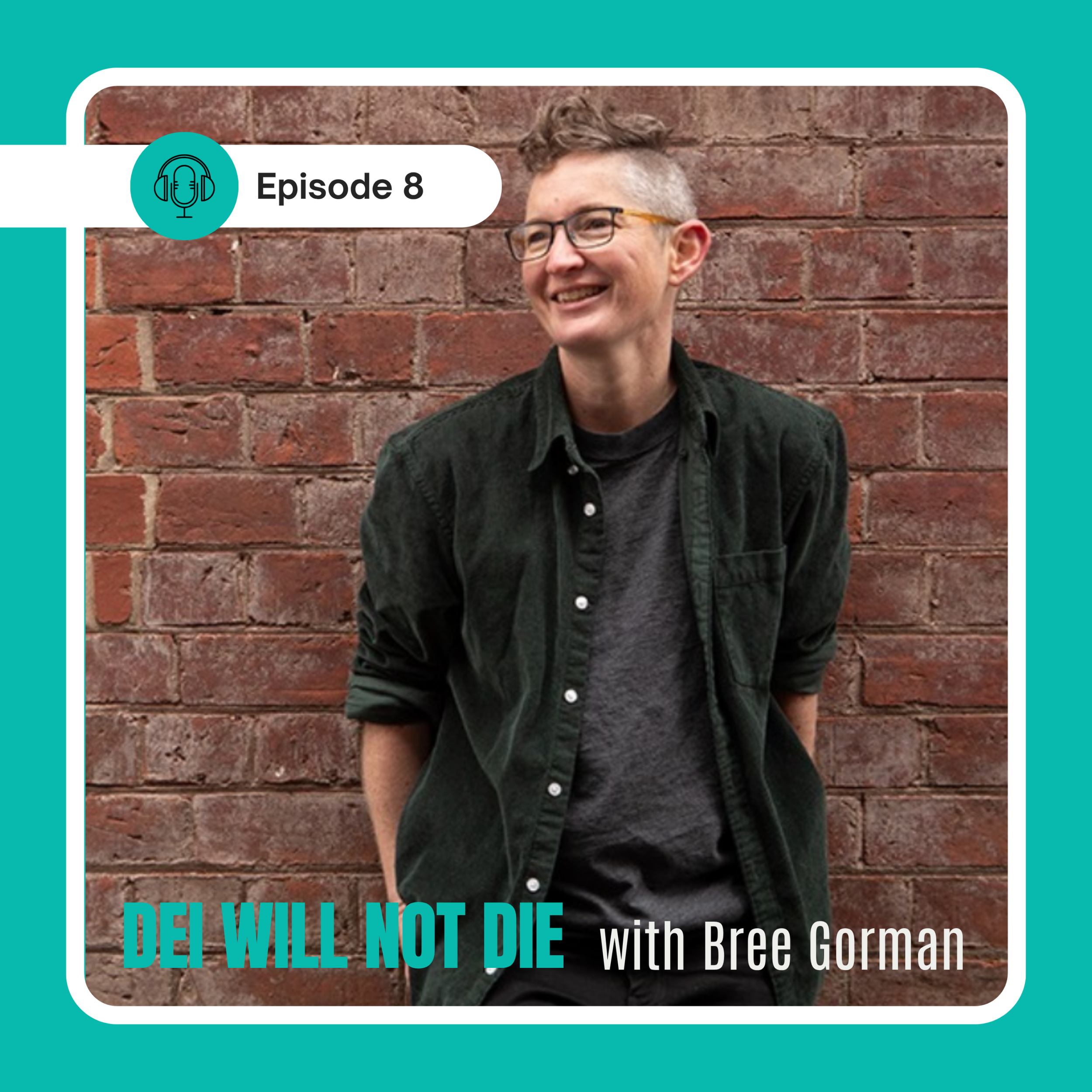
In this episode of DEI Will Not DIE, go behind-the-scenes with Dr Bree Gorman as they share how their background in analytical chemistry became an unexpected foundation for a career in DEI.
They unpack how skills like stakeholder engagement, critical analysis, and bridging divides across disciplines translate directly into creating more inclusive workplaces.
Bree also opens up about navigating work and family choices, managing ADHD as a leader, and what inclusive leadership really requires, focusing on outcomes, not hours, and removing barriers that keep talented people from thriving.
What You'll Learn
● Why “expert” isn’t the right label for DEI work
● The value of collaboration and sharing space among consultants
● How to protect DEI practitioners from burnout
● What organisations can do to meaningfully act on consultant feedback
Resources Mentioned
● Inclusive Leadership Workshop – your springboard to organisational change
Keep Learning & Connect With Bree
Want practical strategies for navigating resistance and building real momentum in your DEI work? Access my free webinar on evidence-based DEI strategies here. It’s packed with tools you can start using today.
If this episode sparked ideas or questions and you want to talk more about how I can support your team or organisation, book a free 20-minute call with me. I’d love to hear what you’re working on and explore how we can move the work forward—together.
And don’t forget to subscribe to my newsletter for fresh insights, events, and tools to support your inclusion journey. Because real change doesn’t happen in silence.
-
[00:00:00] Is DEI dead? Not even close. I'm Bree Gorman and this is DEI Will Not Die the podcast for people doing the real work of inclusion. Whether you are leading a team shaping DEI strategy or just trying to make change that lasts. You're in the right place. We will cut through the fluff and dig into practical insights that will help you lead with clarity, courage, and impact.
Want more tools and support? Head to breegorman.com.
So no DEI, it is not dead and I'm here back to talk about. My journey into diversity, equity, and inclusion. Now, the reason I am talking about my journey today around DEI, this is not a planned episode. I had a different topic I was gonna talk [00:01:00] to you about today. But I am in a very, I don't know what you call it when your ADHD is at its maximum peak.
This happens to me before I go on holidays, so I'm a couple of hours off, logging off for a week off. I'm off to play cricket. Um, you'll be listening to this episode after I've had done the cricket, so I might post. How I went if I actually made any runs. But I am about to head on a holiday, and the reason you need to know that is because when I am preparing for a holiday, my ADHD spikes, it's a complete overthinking to try and get everything sorted and organised, combined with the excitement of the dopamine kick I'm gonna get on holidays.
For those who don't have ADHD and struggle at times to understand, you know, you see external behaviors from those of us with [00:02:00] ADHD, and sometimes it can seem really confusing for me. I do struggle a lot with executive functioning, so that means the admin tasks and the organisation and the logistics.
I'm actually quite good at those, but I'm not good at keeping the train of thought and remembering everything that needs to be done, and lining it up and getting things in place and making decisions when I'm in that mindset as well. So over a lifetime of this, early on in my life, I experienced the really negative implications of not doing this stuff well.
So you're planning for a holiday and you don't plan everything right, and you get stranded. You're in a substandard accommodation. That's if you've managed to book accommodation at the right time, on the right dates in the right place. So over a lifetime of experiencing this, you can, and I certainly have become really hypersensitive to it.
And [00:03:00] you then do more planning than most people would for a holiday. You overthink things. For me, I do a lot of this stuff early and over a long period of time, so there's just a lot of energy goes in into the preparation for a holiday. So I'm in that space where my brain is wanting to think of all of the things that I need to pack yet, or all of the things that I need to do and have ready.
And of course that goes into over planning mode. So there are things I don't really need. To have or to do, but my brain wants to do all of those things to get myself totally prepared for this holiday so that I can have the fun. But it's a work day and I have things to do, and I am not actually on leave yet.
So the episode, as I mentioned that I had planned is going to have to wait because my brain's not gonna be able to function on that more. Research heavy topic that requires me to [00:04:00] actually, you know, to be clear and ordered with my thinking. And if you've been listening in for these first four minutes, you'll notice that my thinking isn't necessarily very ordered at the moment.
So that gives you a little insight if you are a leader managing neurodivergent staff, or even if you're ADHD yourself and haven't quite either realised it or put these things together or just need to have some validation that this is a thing that happens, that we might become very unproductive in the lead up to a holiday.
So instead of talking about the topic that you're gonna hear later on, I'm gonna talk about my journey to become a DEI consultant. Because people often ask this very regularly, book a call with me to talk about how they might get into DEI work and what my pathway was. And often the first question is, well, what qualifications did you do?
And I have qualifications, but they're not in DEI. [00:05:00] And nowadays there are some. What appeared to be some good options for qualifications to support this work, but it's not something that was around when I started doing the work. So I learned on the job and I think that's okay with this work. I think there's value in education.
I have a lot of history with education and as an educator these days, I would, yeah, absolutely. Give a thumbs up if you were considering moving into this space and we're looking at education pathways to do that, but I would probably say that the majority of people in DEI roles don't have a DEI qualification, so it's not a necessity.
Might give you extra advantage in that job hunt, but it's certainly not a necessity and I'll talk about a bit later on, perhaps the skills that I think are necessities to do this work well. But let me backtrack. I started out [00:06:00] as an analytical chemist and there's another leading DEI practitioner in Australia who also started as an analytical chemist, which is quite interesting.
It sounds like it's something that's so different from the work that we do. On a day-to-day basis in DEI, yet the skills from that science background I'm using every day, it's quite incredible how transferable a scientific education is into this work. Even though on the surface you might think that it's not.
It wouldn't be connected at all, but the obvious one is the data analysis skills, the research thinking, the ability to be able to identify a research problem and then design a strategy to try and solve that problem or to expose more about that problem. So those methodologies and that way of thinking are [00:07:00] incredibly useful.
And then of course in a science education, you learn how to then communicate. And translate your knowledge, which might be at a, you know, more academic theoretical point and you learn to translate that to a lay audience, to an audience of people who don't understand necessarily the intricacies of that data analysis that you've done.
And so that science communication skillset that I developed during that time of that study. Has been incredibly useful and relevant for this work. So that's how I started and I was reaching the end of my PhD in analytical chemistry and there was a couple of options that were presented to me. Well, actually, to be honest, there was one option and the option was that you should go and do a postdoctoral [00:08:00] fellowship.
Had to be overseas, and then you do that for a couple of years and then you return to Australia and you can continue on your academic path. That was the main option. Other options were to go into commercial work, being a chemist, which many of my peers did. From an academic perspective, which is what I thought at the time was, was my path.
It was presented that the only option was really to get an overseas postdoctoral fellowship, and that was presented to me by my professor and from others in the department at the time. Now I was approaching 27, I think, as I was completing my PhD, and I was kind of in the mindset that I was gonna start a family.
I had, what did they say? Drank the Kool-Aid. I absolutely believed that the biological clock was ticking and that I needed to have kids. And actually, one, it was almost like one day I woke up and just [00:09:00] realised it was time to have children. It was like some kind of like, it is like a biological clock in a way.
It certainly was for me, and so as I'm contemplating starting a family, the thing that feels really impossible or hard to do at that time was to go overseas and do a postdoctoral fellowship. My husband at the time was unable to travel for his work. His work needed to be in Australia, and so I was faced with this.
Kind of decision, do you follow this academic career that you've spent the last eight years working towards and potentially forego starting a family? Or do you find another way to earn your money and find a job that might give you parental leave? Stay in place where you could raise children. Um, raising children, for me overseas was not an option.
I wanted to be around family to support me so that I could [00:10:00] work whilst raising kids. And so that meant staying in Australia. Now I can see now, and there was certainly people at the time that I. Just wasn't as aware of who managed to get postdoctoral fellowships in country and didn't have to travel overseas for that.
But that's not how it was presented to me. And this is part of what we see as, you know, we call the leaky pipeline people who are educated, who are on a particular career track and then decide to start a family, or they then start a family and being on that same. Track. Of career progression is not gonna work with the starting of a family.
So I realised that if I did wanna do that, then I needed to find myself a job that was an ongoing contract because then I would get access to parental leave. And this is still decisions that people are making [00:11:00] now. Like we know that. My husband at the time did not have access to flexible work, so that wasn't an option.
It had to be me who could access that. So I needed to find a job that could give me flexible work and give me parental leave. So fortunately for me, I managed to. Make a pretty smooth transition from the academic work into professional work. So in higher education, for those who aren't familiar, there's those who are academics and who are on the education research side of the organisation.
And then there's those who are called professional staff. And so there your accountants, your HR folk, your student services counselors, librarians. You know, a whole bunch of different roles that people fulfill at a university, and they're called professional staff because they're not actually, they're not academics.
And so that's what I did. I took on a professional staff [00:12:00] role that at the time was about building research connections with industry, and I ended up doing that for a good eight years through two lots of parental leave. The role changed significantly over that time, but what it always focused around was the commercialisation of research industry partnerships and the management of research projects.
And so that gave me some. Wonderful skills to transfer into this work, right? So it was about stakeholder engagement and management. It was about business and what makes things viable and how you market and how you bridge the gap between academics and industry, which is actually still quite useful skills and tools that I use when we're bridging the gap.
You know, between leaders in an organisation and employees who wanna see more inclusive environments. When you've got two groups of people who [00:13:00] you need to bring towards the same goal, but actually have really different performance measures and different objectives in their work, and how we bring those two groups together, that was skills that I really had to refine during that time doing that work.
There came a time doing that work where I no longer felt aligned from a values perspective with the work. I had seen a number of projects that didn't deliver on what they had promised, and this was, you know, the accessing of government funding to do really important research, but there just wasn't translating into real world outcomes in the way that these projects were designed to.
And it started to become a bit difficult for me to keep working in that environment. And I've talked a lot quite recently to DEI practitioners and people working in other spaces where they're, [00:14:00] at some point their values are no longer aligned with the work that they're doing. And the toll that that takes on you is not to be.
Brushed off. It can be quite significant. And I've been doing some research around this too, in terms of how important it is that our values align with the work that we're doing and, and also how neurodiversity plays into that as well. But I'd come to that organisation realisation and was at the same point going, well, what else do I do?
My entire career has been in higher education. I work in a regional town, so there's not a lot of job options, and I had young kids and I still wanted to be working part-time. So there were a fair few barriers in place in terms of finding a new career, something that would engage me and align with my values.
And I was very lucky that I had a mentor who rang me up one day knowing that I was. [00:15:00] Looking for my next career. And she said, have you seen this job about gender equity? She said, I saw it and I read the skills, and I thought of you instantly. And I thought to myself, what? Gender equity, like I've come from a science background, this, this doesn't make sense.
I was connected with the topic clearly, having been someone who was a product of the leaky pipeline and was seeing constantly the effects of the gender bias and barriers that people, that researchers were facing. Researchers who I was working with. So I had an acute awareness of it, of the topic, but nothing more than that.
I wasn't somebody who had done any gender studies. I wasn't somebody who had even been part of advocacy groups. Necessarily In my teenage life, I was very invested in social justice, but that kind of wavered when my hyper focus got onto chemistry, and that's where my [00:16:00] mind had been on research and chemistry for so many years.
And I looked at this job and it was a significant demotion in terms of pay and status, and it was a contract role at the time, and it was advertised as full time. So there was nothing about this role that really was that attractive other than this could be an opportunity to start something new. So I did look at the skillset and I had them.
And I thought, you know what? Why not? Let's give it a go. And so I put my application in and I had an interview and they selected me. And so then I had to have the awkward conversation 'cause I'd applied for a full-time role knowing that I wasn't prepared to work full-time. This is the game. Sometimes we have to play.
Right, and so then I had the conversation when they offered me the role. Yeah, look, I really like the role. I think it would really suit me. I look forward to the challenge, but I only really wanna work three days a week. [00:17:00] And we had a negotiation process where it ended up that I worked four days a week.
One of those days was at home. And so as my mentor said to me during this time as I was negotiating that she said, you know what, Bree, you'll do in three days what others would do in five. And I really took to that advice. And fortunately I was in an environment where. I could live that. And I think we need leaders to be more willing to focus on outcomes and not time so that people who can be great at jobs actually get the jobs and that these barriers aren't in place for them.
And you know, many of you listening know part-timers absolutely work just as hard, if not harder. Than full-timers and can get their full work done in three days. Not that they should have to. We should be reducing their responsibilities in a role when we're making it part-time, but [00:18:00] part-timers can be very efficient.
And you know, if you know that you've got certain outcomes that need to be delivered, then you focus on delivering those outcomes, and that's certainly what I did, and I got very fortunate. From there, I got promoted quite quickly into a management role. Probably before I was ready, if I'm honest. In fact, entirely before I was ready, I didn't have the knowledge and the expertise in this space.
Now I look back and go, wow, I wouldn't put someone like me in that role. But it gave me the opportunity to learn very quickly in the hard spaces on the spot, and I managed to build my DEI career based off those early roles in DEI. And I, fortunately had some amazing people around me, and I think, I think everybody says this all the time, right?
You need to have good mentors, but you really do, and you need to have people when you're working in the DEI space, who you can lean on. Who you can vent with and who you [00:19:00] can really learn how to do this work in a way that maintains your own health and wellbeing. Because this work is not easy and it does constantly question your own identity, particularly if you bring lived experience into the work, it puts you in positions.
That are incredibly challenging on a regular basis, and you need people to be able to say, Hey, you know what? It's okay that you didn't say all the right things then. Or you know what? That person was being an arse like. We need to surround ourselves with that folk. With those folk. And I was lucky that I really had that early on in my, my career, and now I proactively create that and reach out for that because it's needed and it's necessary.
So that's how I got into the work. I spent about four or five years doing the work. Inside an organisation and then stepped out on my own to run my own business, [00:20:00] and been doing that for six years now. Maybe in a future episode I will talk about the journey of actually running A DEI consultancy, because I know there's some listeners who.
You know, ponder whether that might be the right move for them or are already in that space. And it's always nice to hear other people's stories and, and how they're surviving and thriving in, in running a business. But I just today wanted to talk about that journey. Now, before I wrap up though, I wanna talk about the personal side to all of this too.
You would've heard me mention that I had a husband and had kids. And it was actually when I first got this, my role in gender equity in STEM that I had. I was divorced at that point and I started to explore my sexuality. In the safety of a team that was focused on inclusion, it become part of the passion as to why I [00:21:00] am so committed to creating workplaces that are inclusive.
Because sometimes for some of us, the workplace is the place where we can find ourselves, and that has been such a life changing thing to have happened for me. So I was able to find. You know, discover my sexuality that I knew about but had buried and hidden for so many years. And then in time I just, you know, really was able to lean into my gender identity and have language around that.
And that's what the work brought to me as well. So when you hear passion coming from me around diversity, equity, and inclusion, it's not just. I love the work and I am passionate about creating equity and and equal outcomes for people with all of the diversity of backgrounds that they have. This work also helped me find myself, and so I am quite committed to the work and the value that it brings.
So [00:22:00] hopefully, well, I don't think that was too scattered if I was to rate myself. I think we've done pretty well with a, with a scattered overthinking, dopamine seeking mind at the moment. It's as good as what you were gonna get today. So thank you for sticking with me and I hope. You know, there was something interesting or useful out of that.
Please feel free to send me comments and questions. Really happy to answer and you know, and to hear your stories and thoughts too, which I really love as part of this. So de I will not die. Or there's still those of us who are really committed to the work and while there's still barriers. In the workplaces that we desperately need to mitigate and reduce and kick down all together.
So I'll catch you next time, and in the meantime, please send me through your journeys and your thoughts around how we get find ourselves in this diversity, equity, and inclusion world.
Well, that's it for today's [00:23:00] episode of DEI Will Not Die. Want more resources and support to do the work Well, why don't you visit breegorman.com and don't forget to follow or share this episode with someone who cares, and maybe also someone who should.