
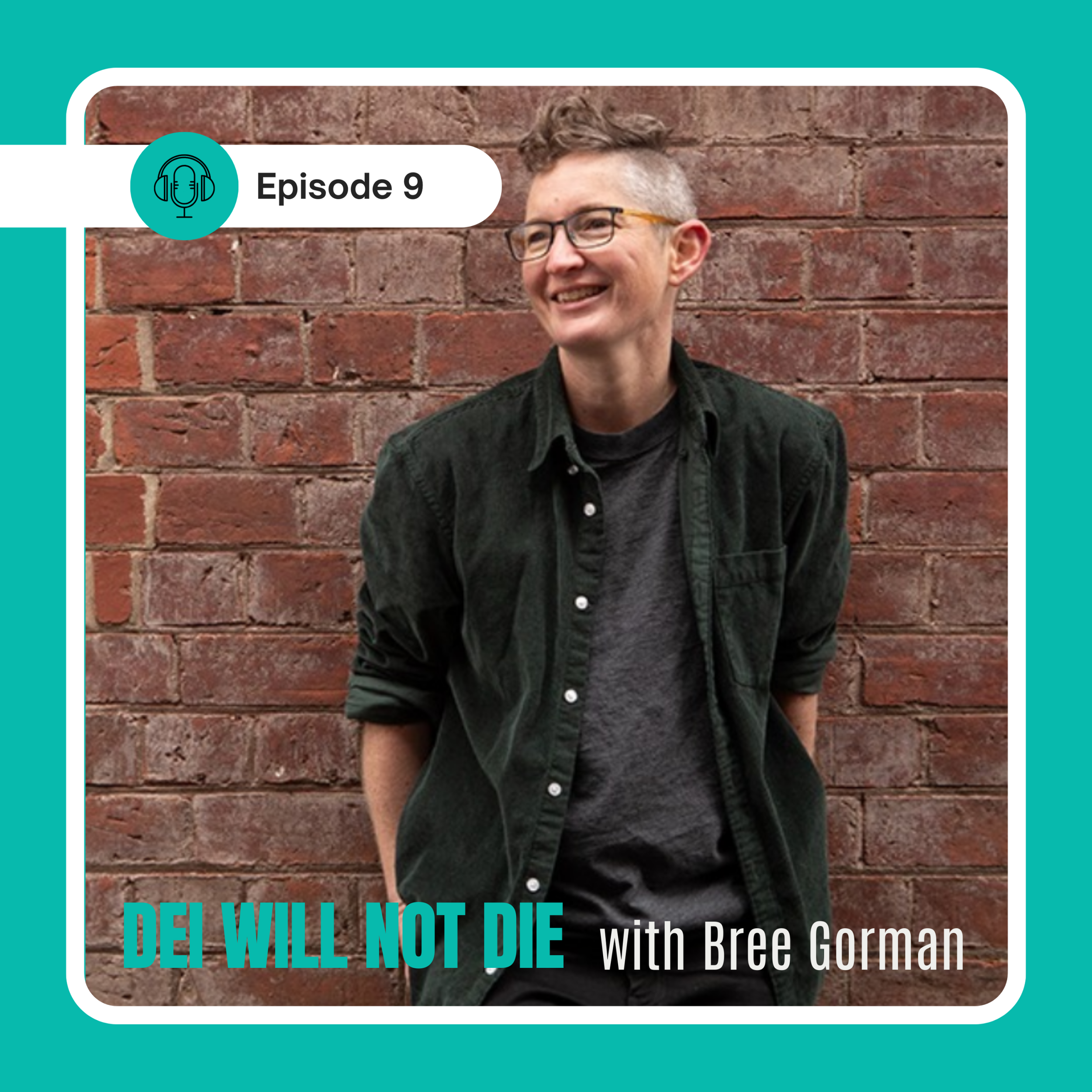
Episode #09
Calling In, Calling Out, and Calling On
About This Episode
In this episode of DEI Will Not DIE, Dr Bree Gorman dives into what it really looks like to respond to negative behaviours in the workplace with both clarity and care. From microaggressions to bullying, harassment, and discrimination, Bree explores how we can support each other in the moment and how leaders can set the tone for safer, more inclusive environments.
Drawing on research, real-world experiences, and lived expertise, Bree unpacks the power of calling in, when calling out is necessary, and how calling on can help organisations step into genuine shared responsibility.
What You'll Learn
● The difference between calling in, calling out, and calling on
● How to address harmful behaviour with empathy while still setting clear boundaries
● Why shame shuts down learning and what to do instead
●How your own safety, privilege, and power influence your approach
●A real-life example of calling in during a community sports game and why it mattered
Resources Mentioned
● Trần, Loan (Ngọc). “Calling In: A Less Disposable Way of Holding Each Other Accountable”
● Black Girl Dangerous, 2013. Ross, Loretta J. “Don’t Call People Out—Call Them In” (TED Talk, 2021
● Calling in, calling out and calling on: Rethinking how we respond to bias at work
Keep Learning & Connect With Bree
Want practical strategies for navigating resistance and building real momentum in your DEI work? Access my free webinar on evidence-based DEI strategies here. It’s packed with tools you can start using today.
If this episode sparked ideas or questions and you want to talk more about how I can support your team or organisation, book a free 20-minute call with me. I’d love to hear what you’re working on and explore how we can move the work forward—together.
And don’t forget to subscribe to my newsletter for fresh insights, events, and tools to support your inclusion journey. Because real change doesn’t happen in silence.
-
[00:00:00] Is DEI dead? Not even close. I'm Bree Gorman and this is DEI will not die the podcast for people doing the real work of inclusion. Whether you are leading a team shaping DEI strategy or just trying to make change that lasts. You're in the right place. We will cut through the fluff and dig into practical insights that will help you lead with clarity, courage, and impact.
Want more tools and support? Head to beegorman.com.
Well, hello there. I am recording this episode just before the Ashes test starts. Now, for those who don't know much about cricket, it's a significant moment in the summer, and I've got a whole bunch of admin to do while I'm sitting and watching the cricket this [00:01:00] afternoon. But I needed to get this podcast episode done.
So let's get it in the 20 minutes that I have space and time for. But it's an important topic that we're gonna discuss today. It's calling in, calling out, and calling on. So how do we respond when we are faced with negative behaviors, whether they be the microaggression type, where. There's not a lot of ill intent, but regardless the behavior or the statement causes harm or has a hurtful impact all the way through to bullying, distress, bullying, harassment, and discrimination in the workplace.
How do we know what to do when I'm a big advocate for active bystander training, particularly the type where role playing occurs. So when you actually take participants through the types of ways in which they might respond to an incident or a situation. 'cause in my experience, the way we get good at [00:02:00] this is actually by practicing.
And if we can do the practice outside of real situations, then we can jump forward in our learning a little bit. And be a little bit more, well be kinder, more empathetic, and more responsive in the moments when it actually does happen for real. But I wanted to explore the different options available to us all today.
And I wanted to do this through the lens of some great speakers, presenters, activists, authors in this space. I'm gonna provide some show notes on this one with some resources that you can go and check out, but I just wanna kind of credit the people who have done the thinking and, and done the that deep work around this topic.
The first one I wanna point out is Lone Tran, who in 2013 had an essay titled Calling In, a less disposable way of holding each other accountable. It was kind of the first introduction of [00:03:00] this idea of calling in rather than just calling out all the time. Of course, people had been doing this, but it was an essay that gave it a name and they wrote that essay in response to burnout and division in activist spaces.
So proposing calling in as an act of love and solidarity, so it's a way of calling out harm. But leading with community and empathy. So pulling somebody aside, maybe not in a way where there's any kind of public shaming. Giving people the benefit of the doubt so that we lead with education and empathy rather than discipline and punishment, right, or shame.
We know that shame is an enemy of learning and an enemy of education and so if we have triggered somebody from a shame perspective, we're unlikely to be able to get them to see what it is they said and how it [00:04:00] might have hurt someone, and also then what they could do differently next time. So much of this work in diversity, equity and inclusion is creating spaces where people can make mistakes and learn from those mistakes.
We don't always, do that. We sometimes, particularly if we're at our limit, you know, we've experienced or witnessed multiple microaggressions, acts of discrimination. We might just not have the spoons or the tools to wanna show up in an empathetic way to somebody who probably should have known better, let's be honest.
Um, but that's not always gonna, if we do that, just direct. Call out all of the time, create that shame. We are more likely to breed and generate more of that resistance rather than hopefully developing some new allies or at the least helping somebody learn just one thing that they could perhaps do differently.
So that's, from my research where calling in came [00:05:00] from, but I'm really happy if people have other great resources to let me know about them too. The other concept I wanna talk about today too is calling on, which was new to me, I came across Loretta Jay Ross's Ted Talk. Where she was talking about calling on as a proactive invitation to shared responsibility, and it's kind of what DEI work is all about, right?
We're trying to call in organisations, we're trying to call on leaders to do things differently in their organisations, to restructure, reshape so that things can be more equitable and fair. And I love putting that language around it, that this is the proactive part, even when we can't address a specific incident.
Harm and sometimes there's reasons why we can't. That doesn't mean we can do nothing. And I talk about this in my workshops to people when we're talking about being active bystanders, sometimes the person who it impacted the most actually doesn't want you to take any action. [00:06:00] They want to protect their career progression, perhaps their mental health and wellbeing, and they just wanna let the situation lie.
That doesn't mean that we do nothing in those situations. We need to flip our mindset to think about, well, this is clearly a problem within this organisations. I can't deal with that specific incident, but what if I helped advocate for change more broadly around say, cultural inclusion or anti-racism or.
Maybe what if I created the space for leaders to come up with a plan or a strategy to prevent harassment or discrimination in the future? And that's the DEI work, right? So I really like this concept of thinking, you know, calling out. There's times when we need to call things out, and for me, calling out needs to happen when it's repeated intentional behaviors.
That are causing, you know, significant harm. Also, if there's situations where there's a whole bunch of [00:07:00] people who witness that, who if we don't say something, we'll go away thinking that that's how things are done around here. And that sometimes can be hard to judge because you still wanna provide that empathy and care to try and educate the person who's made the statement or done the behavior.
But we also want to make sure we're setting a clear boundary around what's expected here in this organisations. And I think calling out is more important when you have a leadership role or you have a position of power and privilege within the space that you're in. But, uh, we need to be really conscious about how we do that, and I think we can call things out in the moment and still lead with empathy, curiosity, and kindness.
I think that has to be the goal. As much as sometimes it can be really difficult to show up in that way. I did like if you don't know about Alok Vaid-Menon , I would seriously look them up. It's just mesmerising to listen to their work. [00:08:00] But they talked about calling out and you know, I guess they were referring to this cancel culture that people describe.
And I think that calling out can sometimes become punishment masquerading as justice. That's interesting. They also describe calling in as a restorative conversation, remembering that we're all learning and making mistakes and that community means holding space for transformation. I just think that's really a beautiful way to look at it.
We do all make mistakes. I still make mistakes. I'll probably make a mistake in this podcast today. And the reason we can continue to show up in this work, even though we're making mistakes, is because we are courageous enough to accept that we've made a mistake, learn something, admit it, and move forward.
And we have to give people the opportunity to demonstrate that. We do have to give a little bit of benefit of the doubt, [00:09:00] like sure, if you've just made a comment. Let me give you an example. I was playing cricket recently and I wasn't in this particular game, but the end of the game, a whole bunch of people were talking about the games that had happened that day.
And in one game there'd been a number of trans women playing, and I didn't really know this, and people started making some jokes about these trans women. Now there is nothing okay about that. And these people who are making these jokes, I would generally consider kind caring people. They should absolutely know better.
But if I go into that moment. Just call them all out directly as being transphobic and demand some form of punishment to happen or, or if I really kind of shame and blame and name them, I don't think that's gonna really have much of an impact. It's [00:10:00] certainly not gonna achieve the objective, and the objective is for those people not to make those jokes again, to look.
At those trans women as people playing the game and not someone to be able to tell an easy joke about. And so instead, I did try and do a little bit of that calling in and said, isn't it fantastic that they get to play? Just kind of ignored the joke. Isn't it? Fantastic, great, what happened at the score?
Tried to redirect the conversation into, you know, the important things, making it clear that I wasn't going along with this joking and this conversation, and not laughing at the joke too. Right, that's an, an action in itself with one particular participant there. The joke did, kept going. They kind of tried to then ask some questions like, or they were statements basically that, you know.
They shouldn't be able to play, essentially. And that's where I took the time to say, [00:11:00] you know what? I'm not comfortable in this conversation. I think trans women are women and they should be allowed to play without being ridiculed. And so then I've moved into more of a calling out space, but it was in private one-on-one with that person setting my boundary, making it clear that I wasn't gonna engage in that kind of conversation.
And spending the time to do a little bit of education in that as well. And my belief is that they may tackle that situation different in the future. I would hope so, but what I was able to do is not push them any into any kind of shame and blame space if they continued, if they tried that again with me.
They would get much more direct answer and eventually I would feel very comfortable calling them out on the spot in public because I've given them the opportunity to learn. So I would expect that that person now does go and do a little bit of learning and reflection around this and get [00:12:00] themselves in a better space in terms of how they might show up next time.
But why was I sharing that story? 'cause it's, it's a highly ADHD day today. But I guess I'm trying to put into practice some of this stuff. There's not no clear boundaries. Calling out, calling in, calling on. It's not a really clear delineation. Sometimes they kind of blur into each other. The more we lead with empathy and curiosity, then the less likely we are to trigger that shame response and therefore lose that person in terms of our ability to educate and bring them in as a community.
Um, and I really love those words from a lock around community means holding space for transformation means acknowledging that we're all at different points and that we can learn and do better. And so that's why I'm a real fan of calling in. I wanna just touch on that calling out point and when it is safe or not safe to call [00:13:00] out.
I've had lots of people in workshops over the years tell me that they really wish they had have said something in the moment that they felt so horribly guilty for such a long time and still carry guilt over an event or phrasing jokes that they didn't call out on the spot and that they never did anything with.
I can relate to this, and I think most of us can, you know, that moment where it happens and then a couple of hours later we think of the brilliant response that we should have used. Right? So there are times when our brain's not processing quick enough to really call things out directly in the way that we would have liked to.
There's also times when it's not necessarily safe for us to call something out on the spot. I encourage people to think about in a moment, what is your power and privilege in that space, in that moment? If you are, as I've said before, a leader, perhaps you are a white man [00:14:00] and it was a sexist comment, then it's probably your turn to do something in those moments.
Right, understanding where your parent privilege sits, if this is gonna be at a personal risk and cost to somebody calling it out, you know, sure, sometimes it's still can be done and should be done, but in other times there might be a better way to approach it that doesn't put yourself personally at a, at a huge safety risk or, you know, in the workplace career risk.
So I think we need to go a little bit easier on ourselves and have a little bit of self-compassion. We're not always got the best answers at that moment in time, but that doesn't mean that we can't do something after things have passed. Then we can take more of a calling in approach. We can go and talk to a delegate, whether it be in HR or our manager and say, Hey, I noticed this happen.
I'm just wondering what the organisations is doing around anti-racism. [00:15:00] Is there ways I can lend my support? Like that's still action that you're taking as a result of that incident. So thinking about your own safety and power in a moment. And also if you can't, or if you don't speak up, still do something.
Whether it's then the calling on or the, or the calling in piece. I just wanna share one more example of when I used a, a calling in approach and if you've attended one of my workshops before, you might've heard this example, but I was watching cricket as many of my stories start with cricket and I was relatively new at this club that I was watching.
It was a men's game that I was watching. It was about five or six of us. They're watching and I wasn't paying a lot of attention to the conversation that was happening. I had my kids with me and I was watching the cricket, but something caught my attention and it was a person referring to another person as an it.
And of course that's raised my [00:16:00] little antennas and I've. Started listening to the story and this woman was telling a story of being at the supermarket that morning and seeing what I would assume was a trans woman in the supermarket. And this person was describing, retelling the story, making fun of the trans woman essentially, and her presentation.
Having hairy arms and a very short mini skirt or something. And so yeah, really like making fun of this person who'd been at the supermarket. So I was really hopeful at that moment that a committee member who was sitting there with us would say something and intervene. The committee member had recruited me telling me how an what an inclusive club they were.
So I was pretty confident at that moment, but. It did not happen. He actually got up and walked away, and I was really shattered by that because at that point I knew it was now gonna have to be my responsibility. [00:17:00] There were teenagers listening, my kids, other adults. This was not something that I could just let slide.
So at this point, my heart's racing, absolutely pumping. How is this gonna be received? I don't even know this person who's telling the story. So what I chose to do was just wait, give myself some space and time. To regulate my emotions. And then I got up and stood next to her and we talked about the cricket, and then I said, Hey, just with that story you were telling earlier, I just suspect that the person you were referring to probably uses.
She/her pronouns rather than it, and you could see her tense up and she took like a big breath and she said, oh, I don't have, I don't have any problem with those people. I don't have any problem with those people. It was just like, if you're gonna dress as a woman, like wouldn't you put in a bit, a little bit of care and attention into like the hair on your arms?
And [00:18:00] your dress. And she released her breath and I released mine and we stood there for a bit watching more cricket. And I said, you know what? I don't shave my legs. I knew that she would see me as a woman, and she looked at me and she said, oh my God, I'm so tired of shaving my legs. And we laughed. And then we started to talk about gendered expectations.
So I said, you know, I think it's really hard how we police gender and how people are meant to show up as a woman. And she agreed with me and she said, yep, she doesn't wear makeup or doesn't believe in doing your nails or any of that stuff. And so we connected over the societal expectations around gender.
And then she said, yeah, you're right. Like I probably could have responded differently. So should I be using she and her? And I said, yeah, it sounds like she [00:19:00] probably uses she her pronouns. I said, and I can't imagine what it would be like. So just be doing something as simple as going to the supermarket in the morning and having everybody staring at you in this kind of mocking way.
And she said, yeah, yeah, I need to think about this differently. That's when I breathe big sigh of relief. And her and I actually then became friends after that. And sure, she was at a very different level of understanding of gender than I was. Yet we had found a way to connect over it and. Somehow she had been open enough to hear what I had to say, which is not something we always get.
You know, that could have just as easily gone very differently, but it didn't. It went the right way. And leading with that storytelling, that empathy and connecting with her, actually I think generated. A really positive outcome for both of us, [00:20:00] and I made sure the conversation was loud enough so the people around us heard it as well.
So I wasn't kind of letting those comments slide. So I wanna share that example, not because I'm like, Hey, look at how good I am at it. But because these things take time and practice and we need to hear stories about how others do it. So I would encourage you in workplaces, even if you don't have the budget to get in a.
Qualified trainer to run active bystander training. Just talking to each other about when you have called things out or called people in and how it's gone for you and being honest and open and vulnerable about that can have such a positive impact on the team and the culture and the organisations more broadly.
So I encourage you to create space to talk about that so that people know what options are available when I do research with organisations, so we're doing focus groups. Surveys we see very often that [00:21:00] people just don't understand what options are available to them. So they have problem understanding whether something is discriminatory or harassment or bullying.
So we need to raise education there, and then they have trouble understanding what role they should play. And whether it's their responsibility to do something or not, and what options they have available to them. And so that awareness and education piece is super important, but it must be combined with that practice piece that I'm talking about.
So, calling in, calling out, calling on. Interested in your thoughts. I hope that's been a useful conversation for you. Share it around with others if you think they could benefit as well. And as I said, I'll put some resources in the show notes for you so you can do a little bit more investigation on the topic.
So, from this conversation today, of course DEI will not die because people are still going to say things that they shouldn't and behave in ways that they shouldn't. [00:22:00] And we need to be there to help kind of guide people as to how we can. Collectively raise the bar in terms of behaviors and in terms of responses to behaviors that exist within our organisations.
Well, that's it for today's episode of DEI will not die. Want more resources and support to do the work Well, why don't you visit breegorman.com and don't forget to follow or share this episode with someone who cares, and maybe also someone who should.