
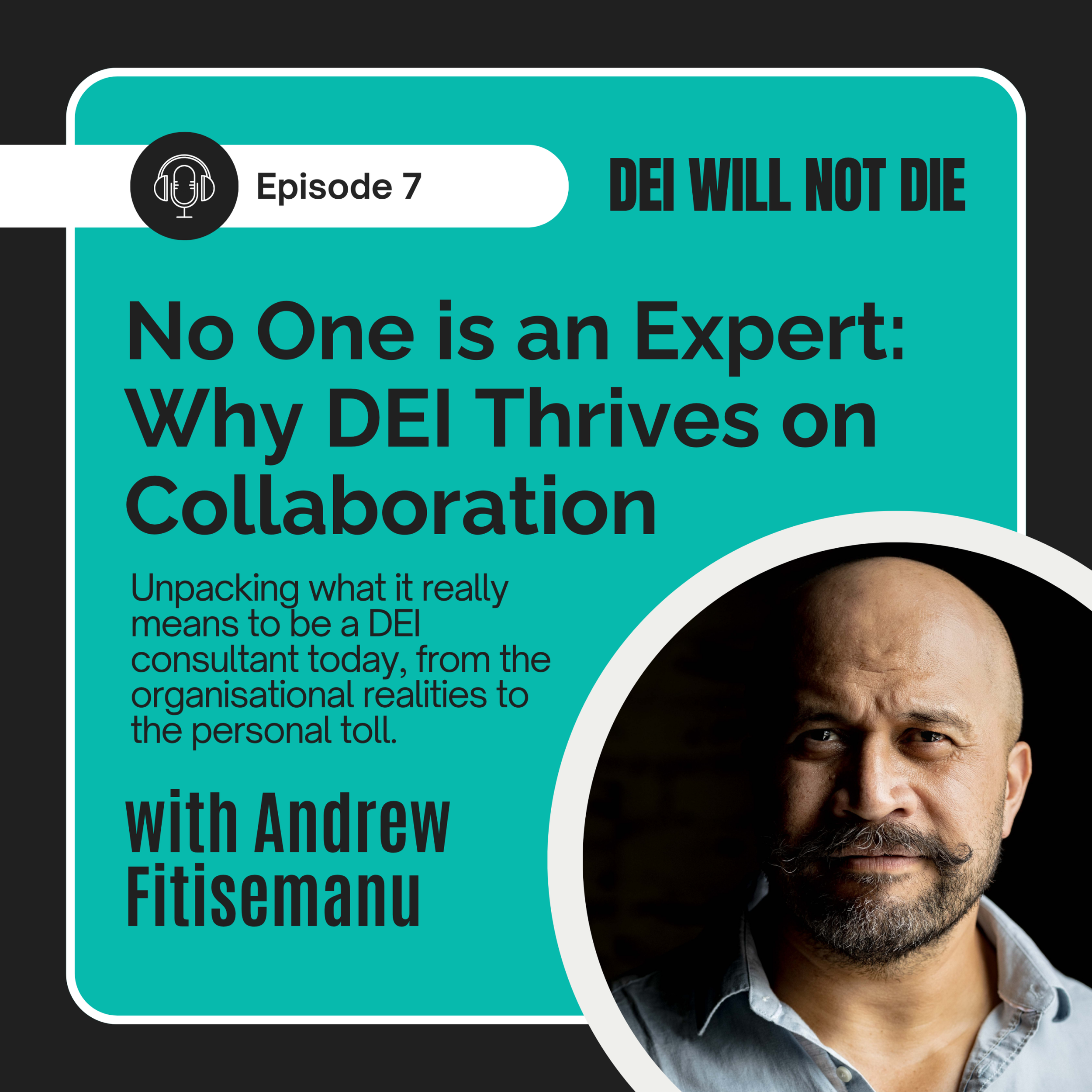
Episode #07
No One Is An Expert: Why DEI Thrives on Collaboration
About This Episode
In this episode of DEI Will Not DIE, Dr Bree Gorman is joined by guest, DEI Leadership and Wellbeing Consultant, Andrew Fitisemanu.
Bree and Andrew unpack what it really means to be a DEI consultant today, from the organisational realities to the personal toll. They explore the myth of expertise in a field that’s still evolving and discuss why humility, honesty, equity and collaboration are key to sustaining meaningful DEI work.
The conversation moves beyond credentials to the emotional and systemic challenges that consultants face. Bree and Andrew reflect on burnout, boundaries, and the responsibility organisations have when they hire DEI practitioners, not just to listen, but to act.
What You'll Learn
● Why “expert” isn’t the right label for DEI work
● The value of collaboration and sharing space among consultants
● How to protect DEI practitioners from burnout
● What organisations can do to meaningfully act on consultant feedback
Resources Mentioned
● Inclusive Leadership Workshop
● Bree’s free webinar: Evidence-Based DEI Strategies That Work
● breegorman.com for upcoming programs and events
Keep Learning & Connect With Bree
Want practical strategies for navigating resistance and building real momentum in your DEI work? Access my free webinar on evidence-based DEI strategies here. It’s packed with tools you can start using today.
If this episode sparked ideas or questions and you want to talk more about how I can support your team or organisation, book a free 20-minute call with me. I’d love to hear what you’re working on and explore how we can move the work forward—together.
And don’t forget to subscribe to my newsletter for fresh insights, events, and tools to support your inclusion journey. Because real change doesn’t happen in silence.
-
[00:00:00] Is DEI dead? Not even close. I'm Bree Gorman and this is DEI Will Not Die the podcast for people doing the real work of inclusion. Whether you are leading a team shaping DEI strategy or just trying to make change that lasts. You're in the right place. We will cut through the fluff and dig into practical insights that will help you lead with clarity, courage, and impact.
Want more tools and support? Head to breegorman.com
And welcome back to DEI Will Not Die. I've got a guest today who I would like to call a friend, who I'm so privileged to know and really excited for the chat today. But before we get started, I do wanna acknowledge that I'm on Wadderang Country and pay my respects to elders past and present [00:01:00] and acknowledge that.
In the state of Victoria, which is where Wadderang Country is based, is that we're in the middle of a treaty process, which is very exciting for the state. I went to Parliament last, I'll say last week, but it won't be last week by the time you're listening to this, but it's a very exciting time, but also I imagine.
A very challenging time as well in terms of the, the baits that rise again and, and the racism that we see, particularly on social media platforms. So acknowledging the challenges with all of that and how overdue this process is, but glad to see the process and have been just blown away by the way it's been run by the first people's assembly.
Victoria, so that's just a little call out to the treaty process here. Andrew, I know you are not in Australia at the moment, so we won't do an acknowledgement of country of your site and we're just having a interesting chat about, you [00:02:00] know, protocols and how they do or don't translate into different spheres.
But sometimes in the DEI world, we try to make them. So did you wanna share a little bit about what you were just sharing with me before? Yeah, thanks Bree and thank you to everyone who's here as well. So I'm currently, um, I've returned back home to my family in Wellington and New Zealand. So I guess where, when I say New Zealand is the country that I'm in, and I think one of the things that I was talking to Bree, which was around acknowledgement to country and welcome to country, which are very strong and important protocols of what we look at within the nations over the 300 different countries of nations that are represented.
And sometimes that with all well-meaning. We love to roll out a policy 'cause everybody loves a good policy. We want to show you that we're acknowledging everyone. So we roll out a policy that fits the territories or the countries that we are within, and then we think, [00:03:00] oh, well, we should branch out to other individuals or representatives.
And I remember I worked for an organisation that with all great intentions, rolled out a acknowledgement country policy, but then we had also operatives who were working in this great country. Where protocol didn't fit, didn't make sense, and they were forced to find some way of making it, adapting it to make it fit.
And I think that's one of the things that causes harm when we actually just don't do the work of what we're actually trying to implement. So I think that from experience has taught me, which is around do no harm, which is I think one of the great principles that I. I tried to follow and live through when looking at policies and also understanding what a risk assessment requirement is that when we undertake these new policies, do we do an actual risk assessment?
Mm-hmm. Do we actually look at who's impacted by this? Do we actually look at, you know, all the amazing nuances [00:04:00] of a new policy and how does it impact on those? But then how does it detract from those that we are trying to uplift? Hmm. I really like this topic and thinking about how we wanna get our systems and structures in place to nudge and create inclusion.
Like that's absolutely a goal, but diversity, equity, and inclusion is so nuanced that sometimes we, as you're describing, we have that risk of putting something in place that works for some, but not for all. And thereby perpetuating the, the lack of privilege or the exclusion through those policies. So.
It's quite a balance, isn't it, in terms of trying to get things standardised and trying to create a, a system and environment that puts inclusion first, but not assuming that we can just apply a cookie cutter approach to every issue. Well, I think it goes. It kind of is the opposite of what we're talking the DEI space.
Where is the equity in that? You know, and I think when we have these conversations around [00:05:00] equality, equity, and I think this is one of the things with organisations and individuals, we need to understand, there's a clear differential between equality, equity. Mm-hmm. And even when I think about corporate roles and, and job descriptions, job titles are probably written as instead of equity, the resident as equality.
And I think that's one of the things that we need to look at from an organisational point of view. Mm-hmm. Does the job title fit the individual and the work you want that person to do? Mm-hmm. Because I think one of the things around when, I think one of the many things, if we wanted to make everything fit in that nice umbrella of equality, and you know what?
A lot more of us would be successful. And I say that in a cheeky way, equality's pretty easy to achieve. It's equity, and that's the hard part. Interesting and when up that which is around, do we have the maturity to understand that equity does not mean that one size fits all or the distribution of [00:06:00] resources is equal to everyone else.
Mm-hmm. You know, I remember working for an organisation and, and we were looking at creating safe spaces for the different ERG groups. We had employee, employee reference groups, and I remember we were looking at creating a indigenous zone. And then one of the questions was raised, what about one of the other ERG groups?
Should we not create a special zone just for them? And my question was, but is that what they asked for and is that what they need? Mm-hmm. By distribution of, I guess, retail space, and let's call it what it is, visual retail space and non-office block, does that equate to the same reference of supporting an organisation or individuals within an ERG?
And that's where I would say no. Yeah, we could give everyone a corner office. But does that achieve the worker equity? Yeah, I like it. And for those who have just tuning into this episode, I think literally the episode before this was about ERGs and I think Andrew, you've [00:07:00] nicely reinforced some of the things that I said in that we have just like launched in like we do, talking deeply about DEI.
I love, but let's just backtrack and I'll give you an opportunity to introduce yourself, Andrew, 'cause I haven't done that yet. Oh. And then, you know, we had a few topics that we thought we might kind of cover today. Generally looking at what it's like as, and I'll get let you introduce yourself, but. You've had experience as a DI EI consultant, I'm have experience as a DI EI consultant, and we wanted to talk about that from an organisational perspective, but also from this perspective of ourselves.
So that's to give the listeners a little intro to what we might cover today. But as you've probably already gathered, we like to just have a good chat about DEI, so we'll see where it takes us. But Andrew, could you introduce yourself to the audience a bit? Of course, sorry, Bree and I think that's a reflection of our friendship, which is we just launched straight into this without thinking about the purpose [00:08:00] of why we're here.
Um, sorry. My name is Andrew Fitisemanu, my name is of Samoan Descent. I was born in New Zealand and my background is in vocational education, also around sports advocacy. I myself am a proud Pacifica male of, as I said, Samoan descent. And I'm also a gay male. One of the components that, I guess what brought me into this space was a series of, I guess, functions that was given to me over the years around creating a Pacifica engagement strategy.
You are a community based athlete wanting it to be part of this campaign. And I think over the years, and this is when I think about spending 20 years years where my work and job roles have started to encroach more into this diversity, equity, and inclusion consultancy role. And so at the moment what I'm doing is I've taken a bit of a sabbatical, and when I say sabbatical, I'm claiming my time back.
Love it. [00:09:00] After a few years, working in, I guess, uh, arranged space, I was talking to Bree before about this where I working in a non-for-profits, corporate volunteer spaces, and one of the things that I realised is that. And I think we could probably talk about this a different time, which is around, sometimes there's burnout and sometimes you need the ability just to switch off.
But my roles have always been around grabbing an idea and actually working out what fits best for an organisation, is the best way I can describe what my consultancy work works within the parameters of what data do we have, what resources do we have? What is the willingness of an organisation to participate and then coming up with a concept or a strategy?
Presenting that to the organisation and where can I, is this where we are? And I think that's the best way to describe me. I call myself a creative DEI consultant because I'm quite used to being given a limited budget. And I kind of have to work out where, okay, if we have [00:10:00] this, this is the best I think we can come up with.
I, I love that. And how true would that be of most people doing DEI work? Like what better profession to learn to do big things, big change on low budgets? I think that's great. It might be, I guess, the cheaper version of the OD organisational development team. Yeah, true, true. Um, one of the topics we wanted to discuss, and I know this is, this is something that I'm really interested in talking about, is this idea of being an expert in DEI.
Do you think it's possible to be an expert in DEI? I'm gonna say flat out, no. And I'll make it really clear for everyone. No, I do not believe you can be an expert. In the DEI space and, and I will give just for all disclaimers, my opinions are my own. And so if you want to come at me, [00:11:00] please do. When I say come at me, ask questions, and I think that's why we talk about we are, there is no such thing as I truly believe as a DEI expert, because we're still in this infancy and I say infancy.
I mean, look at the current topics we have at the moment around trans rights. Let's look at, I guess I'll use the trans rights at the moment, you know, and we are re-approaching territory, which has been quite harmful, threatening and damaging toward a key part of our community. When I say our key community, this is within our queer spaces, and what I find is at the moment is.
Well, hang on. I believe we have repeated fascism before in the past, and we are once again subjected to the same type of mentality, hateful speech, even cruelty to other human beings. I would say if we're experts, we were to solve that problem. And so when I say are we experts? No. I would say that to be an expert would require a level of proficiency in the [00:12:00] space.
And I will put my hand on heart around this one here is that even as DEI consultants, a lot of us will be challenged in these spaces because we'll be given, I guess the crazy problem statement of we have this challenge, can you fix it? And a lot of us are going to say. Deep breath. I can give it a go and let's try something.
But to be an expert requires, I guess a level of proficiency of the qualification. Sure. We all may come from different backgrounds of a, a psychological qualification, mental health backgrounds. But that does not encompass you as being a DEI consultant because some of us work in creative spaces. Some of us work, I guess, in policy, and so one of the things is around can you be an expert?
No, I do not believe you can be an expert, but I can believe you are. You are a very informed, effective individual. I believe that's what A DEI consultant can. Yeah, I would agree and probably have some slightly different reasoning that I've thought about [00:13:00] this over these, is that I think, I think it's too broad de and I in itself, like what does that even mean to be an expert in DEI?
I think we can be, as you said, more of a facilitator of positive change and good impact, and there are people who have great levels of expertise in particular functions. Yep. Policy, inclusive policy, or it might be trans and gender diverse inclusion. Mm-hmm. You know, there, there are narrow niche areas, but in terms of it as a broad concept, I find that concept really hard to grab hold of.
What would an expert look like? Who's somebody who has, you know, so much proficiency in change management there, there. There are so many skills required to do DEI work, and I think if we get into a space where we think we're an expert, we're gonna fail. Oh, because there's so much we don't know. I think we have to be honest, to be able to admit we don't know all of this, but what we can do is try and pull things together and work creatively to [00:14:00] solve a problem.
I agree. And when we take those three words that make up the acronym, you know, diversity, equity, and inclusion, and my experience and interaction with people from our network is that we actually come from one of those three different areas. We're really proficient in diversity or could be so proficient in inclusion or equity.
But if, look in this equation, you know, we're looking at birds and one of the things is that I'm yet to meet, and I love to be proven wrong, to find a consultant who's great at all three areas. Absolutely. When I, I, and that's one of thing, I come from a diverse background, but does that make me an expert in diversity?
Mm-hmm. I work in inclusionary spaces. Once again, I would ask, I don't believe that makes me an expert. I'm far from an expert around equity, but I acknowledge I know what equity is and isn't. Mm-hmm. And so that's one of the things that I would talk about. Can we be a DEI expert? No. [00:15:00] But I would always love to find who's great in an area of expertise and what we can glean and what we can learn from them.
And I think that's part of the work that is really great that I've enjoyed about d and I work is actually the collaboration piece. Exactly. Yeah. And I think if you, if you put that title expert on yourself or on a, or on a DEI practitioner within your organisation, then you fail to see that this is everybody's job.
And this requires, as you say, that collaboration piece to bring in the, the numerous skill sets we need to make this stuff work. I love. What about sharing space? We talked a little bit about this. We have in the past as well. How do we share space as DEI Consultants, and I'll come from the consultant perspective on this one.
Okay, I'm gonna go onto, I wanna say it sharing space. I think about sharing space for us as consultants and I, and I actually think about from an organisational point of view, [00:16:00] so looking at it from not-for-profits and, and I guess commercial entities, is that when we talk about sharing space or as consultants once again.
I struggle with the consultancy work. 'cause organisations will tend to hire one individual who will be their sole operator for all matters around diversity, equity, and inclusion. Mm-hmm. And that is my struggle statement that I have is because. When we talk about sharing space, I look to organisations and they will give me a short list of DEIs public speakers.
They would love to hear, and guaranteed there will be under the top five. I will know four of them and they'll be the same. Four consultants who will speak on every single day of observation. There will be the same four consultants that will participate in panels. Keynote speaking, I guarantee you. Their calendars will be well booked in advance before that day of observation appears.
[00:17:00] Now, this is not me talking about sour grapes. This is not me saying I wish I had more work. What I'm saying is that the distribution of work and sharing space is also relevant to DEI consultants where, and I asked, do we actually have the emotional and intelligence to actually realize that I'm not the best person to speak on this topic?
Do we have another DEI consultant that actually would be a better one here for this opportunity? I think we were talking about this before Bree, which is around, I have seen and experienced so many great new consultants come out there. Really fresh intake on ideas and opinions. And let's be honest, we're talking about ideas and opinions because that's where our space actually fits.
We fit in the space of encouraging ideas. We spin in the space of provoking opinions. And what I tend to struggle with at the moment, and this is a, a global scale as well, is that we tend to have the same consultants popping up every so often and every [00:18:00] opportunity. And I would ask. I love you, my dear friend, but I would love to hear somebody else speak on this topic.
And then things around sharing space. We already know that we have challenges within organisations and I guess a formalised entities that we need to fight for the space that we have. But I also find that as consultants sometimes we are ourselves, are also kind of fighting for space around allowing another voice to come forward.
Do we use our platforms to elevate others? And that's the question I have around sharing space. And I use the I statement because I'm not very comfortable saying I, but I'm going to try to use it more often. And I've always tried to think about the DEI Work is only successful when we actually start to refer work to each other.
When I say refer work DEI consultants also need to be paid a living wage. Yep. Absolutely. organisations. We have formal qualifications. Some of us still have forms of student debt that needs to be paid off. We're not [00:19:00] working in this space just because we love the work. Yeah, we love the work, but we also know that.
We're also really good at the stuff that we do. Mm-hmm. And so I think about the sharing space component, which is around, coming back to it, is I would love the opportunity to see more DEI consultants actually use their platforms and leverage the voices of others. For example, where I really have loved following your work for the last, I don't know how many years now I'm seeing Europe.
Platforms encouraging others to come forward. I've seen so many great voices and new opinions come forward. As a consultant myself, I realised, hmm, that actually challenges the way that I think. I love to be challenged. I say love to be challenged. I need to be challenged because I will become stale. Yeah.
If we think about sharing space, let's also think about the role of A DEI consultant is a professional occupation, and as a professional occupation, it should be treated as such. Yep, absolutely agree. And [00:20:00] you know, I'd add to this conversation, I think sometimes organisations, and rightly so, they've got a very small budget and they wanna engage one person to do the work of 10.
Like that's, I understand the driver to that, but in this space, we sometimes need to recognise, well, if I just get one person to do this work. Then that perhaps isn't covering off on this idea of inclusion and the fact that we might need to get some different voices that we pay. I'm doing a project currently where I've brought in an expert around anti-racism strategies, and I've brought in an expert around disability inclusion into the project, which has meant that actually.
We're not getting what we probably need financially from the project to make it work, but the project quality is quite high because we're bringing in those different voices. But I think for organisations to just sit and consider, as you say that, you know, we can't know everything. One person can't know [00:21:00] everything.
Sometimes we need to bring in other consultants to work with us, and we kind of need to fit that into the budget to create that impactful work. Oh, and I love that you talk about, you know, let's talk about really the hard issues as A DNA consulted budgets. So I love this one. When we look at days of observation.
Mm-hmm. And sorry, for an organisation, typically we would have a calendar of days of observation, dates or idea. So we plan a series of events. We plan a series of strategic targeted events that are specialised for specific for this organisation. But I would actually ask organisations when they go, oh, could you throw something together?
And I'll go, great. Let's be quite honest about this because for an order for us to secure a keynote speaker, three to $5,000 mm-hmm. Let's be honest about that. To hold a workshop would also need to hire an A venue. When we ask a venue, let's look at catering. People go, catering is like going, yes, people need to be fed.
We ask them to take a day out of their work schedule. When [00:22:00] we asked for marketing campaigns. Somebody from marketing also needs to put in their set hours allocated to design a marketing piece around that. So that gradually adds up. And that's where when people say, when I, when I say people, I'll say entities would love to say, can you just throw together event and say, oh, because you know, sometimes just don't have the budget.
And I'd also come up with something like different, where it might be, Hey, we could do an online forum. And I'd go, oh, but it doesn't give us the bang we wanted. And I would once again ask the question. Why are we doing this? What is the objective? Absolutely. Are we doing it for likes? I dunno. Mm. Yeah. And that goes back to your thoughts around we need to be creative.
What's the objective of the event and what's the best way to get that objective met? And is it necessarily a traditional in person? Talk at a audience type event, or are there other ways we can get that objective met that might be more effective, that creativity is important? Oh, and [00:23:00] creativity is one of, I think is one of the most successful hallmarks of A DEI consultant.
A DEI consultant can be quite successful for an organisation. What I find is the other challenges the organisation has, I guess a different view of what they would deem as successful, and I think that's one of the things around when you hire A DEI consultant. Entities, and I say organisations. Are you willing and prepared to take on the feedback of the DEI consultant?
'Cause that's what they're hired to do. You hire them to give you an opinion and to deny that opinion. I would think, you know what, you're just flushing money down the toilet, literally. Mm-hmm. 'cause they would provide you back with the evidence. They would provide you back with the rationale for it. And I think that's one of the challenges for why, I guess part of the DEI is not dying.
It is because. We have put DEI strategic work on such a platform in a scale, which has now become this whole marketing machine. And it's all about collaboration and partnerships now. Mm-hmm. And I think [00:24:00] what gets left behind is the entity or who gets left behind and it's the individuals that we're actually trying to help.
Mm. Final topic for our conversation. Yeah, because I know we, we should wrap up soon, but I am interested to talk a bit about DEI burnout with you. I know I'm in a current practice of having. Multiple mini breaks throughout the day, um, to avoid heading into burnout space, which is an active practice that I have to take.
And I have to be really conscious of day-to-day how I'm tracking. 'cause you know, burnout is common in lots of professions and lots of roles, and I think there's some nuance and some complexity around doing this particular type of work and. The way it can lead into burnout and we know research and evidence has shown us that that is the case.
What are some of the things that you think need to happen to protect, I guess DEI, [00:25:00] practitioners, consultants from burnout? I love this 'cause we were talking about this before and I think one of the things that we need to, as people, I'll say people, we need to actually protect our practitioners and consultants in the space of allowing them to turn off.
Allowing them the ability to finish off their day at 5:00 PM and just go home and do whatever they need to do, not to bombard them with the question. I think I used this scenario before. When I started one of my DEI roles and I remember being told by a friend in the, in our queer community, they said, oh, that's a very woke job role.
And it, it taught me something very quickly. Then I'm going to be very protective about the work that I do and when I share it and how I share it. Mm-hmm. And I think one of the things around the DEI is that organisations need to be mindful about the psychological load that you place on this individual.
We become as consultant and some of us are really [00:26:00] great at it and some of us aren't. And I'll be really clear, some of us are not great at carrying the psychological trauma burden. Mm-hmm. The AT companies, this role. Yeah. And I think that's one of the things we need to be mindful about the burnout. 'cause the burnout is.
We get stopped on our way to the bathroom and we've all been there, need to go to the bathroom and somebody will say, stop. I have a question for you. And it's one of those things that as a role, can we actually tell that person? Can I come back and see you in 10 minutes? Some people are great at that, but some of us know that we missed that opportunity with the individual.
We won't get it back. And so when I talk about that burnout is organisations, I don't wanna say colleagues, be mindful of your DEI consultants by giving them space. I had that start in a policy where I was at my desk going, if I'm at my desk, it's annoying no flies or an area. I guess I just need to get these thoughts down on paper and then I'll come out and find people.
And once I leave the desk, it's like, great, let's keep going. We need can grab you. And I think that's one of the things around burnout, which is my thoughts [00:27:00] are to your colleagues and to your organisations, is to give that person space and protect their space as well. And I think they talk about space and it's like, you know, it could be a IC space.
iCal space, but when I think about. Giving that person space, we need to also protect that individual as well, because you don't know what's happening to the home. For example, I know that I've ch, I've been challenged on the street. I even remember I went to a friend's dinner party for a birthday and I was told by a person of privilege that it was my obligation to continue the work outside.
My work hours in my own personal life. Wow. Yeah. And I think that's one of the things that when we share those stories, people go, oh, but that's your job role. And I go, well, that's the same for every other professional, but they're allowed time off. Yeah. And I think that's when burnout, burnout actually happens to us in the spaces where we think we're safe.
Yes, that is true, and I can relate hard to that [00:28:00] in that I've had to learn that I don't have to be the DEI consultant in all of the spaces. So at the local cricket match, I don't have to be the DEI voice. I can actually spend an afternoon. Putting a wall up on that and just being a spectator at the cricket.
Exactly, it's, it's not like we walk around with this kind of flashing light saying, Andrew, the gay rugby player. You know, it's not a flashing, it's like, no, I just came to watch my play rugby. That's all.
Yeah. I'm gonna have a good time. But I think that's one of the things around where burnout happens. It's in the spaces where we least expect it. Yeah. And the passion that that has brought us to the work in the first place is actually really hard to dial down in those situations. 'cause you hear the comment and you see the action and you've just spent the week teaching people how to be active bystanders [00:29:00] and you, and you need to follow through on your, on your values and you know, actually do what you're teaching.
But at the same point, that's what then can lead us to. It's a burnout. Yeah. Yeah. I love this conversation and just thinking, I guess it's, it's, that's the thing, right? Just putting more thought into when we have the energy to, to do the work and how we're proactively protecting ourselves, and as you are describing how the organisations are then proactively protecting the people who are doing this work, whether it's the practitioners or whether it's people in employee resource groups.
You know, have we actually thought about this and put some things in place. Oh, we've, I've loved this conversation and, you know, can't wait to have another, but I know we should wrap up. Sure. Andrew, just thank you for coming along and sharing so openly and, and honestly like your thoughts and ideas and really provoking some, some conversations that I think listeners will be going away and, and talking about and thinking about.
I'm [00:30:00] expecting a few messages from this episode. Thanks. A huge thanks to all of those who are listening in. I know the podcast is quite new, but I've been, you know, really boyed by the comments that people, or questions that people are sending through. So keep doing that, and of course, as we say, DEI will not die.
It adapts, it changes. And we do better and we learn more, and these kind of conversations are hopefully contributing to that. So thanks for listening in everyone. Thanks, Bree. Thanks everyone.
Well, that's it for today's episode of DEI will not die. Want more resources and support to do the work Well, why don't you visit breegorman.com and don't forget to follow or share this episode with someone who cares, and maybe also someone who should.