
How do we engage men with gender equity?
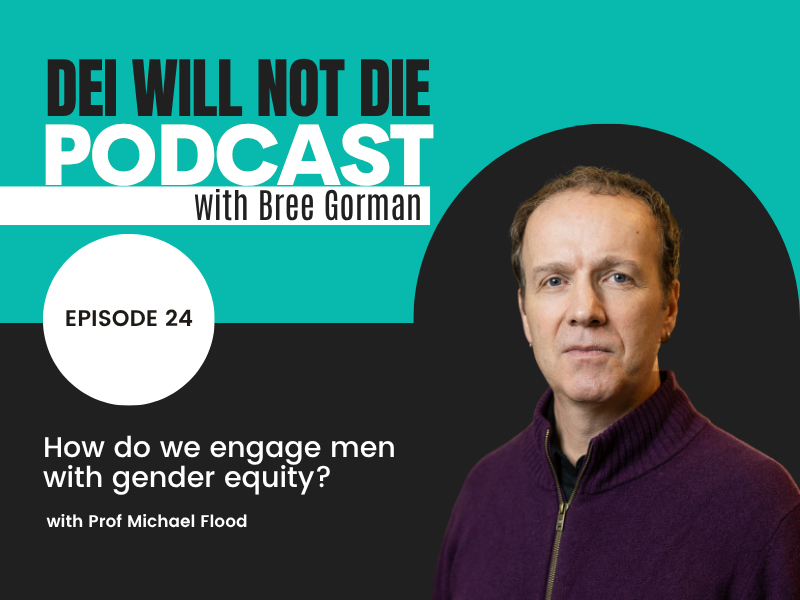
About this Episode
Bree is joined by Professor Michael Flood, a researcher at Queensland University of Technology with over 30 years working on men, masculinities, gender and violence prevention. They dig into the question that comes up at almost every DEI or gender equity event: how do we actually engage men in this work? Michael unpacks why men are less likely to recognise everyday sexism, how misjudging other men's attitudes keeps good men silent, and what workplaces get wrong about parental leave. The conversation also explores a recent paper on care and masculinity, and what a "care lens" on violence prevention could mean for how organisations approach accountability.
What You'll Learn
Why efforts focused only on empowering women can inadvertently place the burden of change on the people most disadvantaged by workplace systems
The specific ways men under-recognise everyday sexism compared to more overt harassment, and why that gap matters
How "social norms" misperceptions keep men silent, and why naming actual majority support for gender equity can shift behaviour
What a care-based lens brings to violence prevention, including the idea of "compassionate accountability"
The structural and economic barriers (like the gender wage gap) shaping which parent takes leave, and what policy levers like dedicated "daddy months" have done in Nordic countries
Why breaking down rigid ideas of "real men" matters as much as promoting positive models of masculinity
Resources Mentioned
Engaging men in building gender equality: Key resources: https://xyonline.net/content/men-building-gender-equality-guide-xys-content
Men building gender equality in the workplace: https://xyonline.net/content/men-building-gender-equality-workplace
Engaging men and boys in violence prevention: Key resources: https://xyonline.net/content/engaging-men-violence-prevention-walking-tour-some-xys-content
Professor Michael Flood’s writings & speeches: http://www.xyonline.net/category/authors/michael-flood
Keep Learning & Connect With Bree
Want practical strategies for navigating resistance and building real momentum in your DEI work? Access my free webinar on evidence-based DEI strategies here. It’s packed with tools you can start using today.
If this episode sparked ideas or questions and you want to talk more about how I can support your team or organisation, book a free 20-minute call with me. I’d love to hear what you’re working on and explore how we can move the work forward together.
And don’t forget to subscribe to my newsletter for fresh insights, events, and tools to support your inclusion journey. Because real change doesn’t happen in silence.
-
Episode 23: How do we engage men with Gender Equity?
with Professor Michael Flood
Bree: Hello and welcome back to DEI Will Not Die. I was just having a conversation with today's guest, trying to think about when it was that I first came across Professor Michael Flood's work, and I think it was about 11 or 12 years ago. I have been a fan since. So you're in for a treat today, I am sure.
Before we get into it, I do want to acknowledge that I am on Wadawurrung Country, and pay my respects to elders past and present. A call out to any Aboriginal or Torres Strait Islanders who are listening in today, and an acknowledgement that there is some pretty horrible racism going on in this country and around the world at the moment. If you're listening in and you haven't caught the last couple of episodes, there have been a few recently on anti-racism and what organisations can be doing. I'd encourage you to go and have a listen to those incredible voices that have come on this podcast over the last couple of months.
Today we've got Professor Michael Flood. Michael, I'd love for you to introduce yourself to the audience if you could.
Michael Flood: Sure. So as you've heard, that's my proper title, but Michael is fine. I'm a researcher at the Queensland University of Technology, up in Brisbane, on Turrbal and Yugara Land. I've had a long involvement, over 30 years, in research, advocacy and education on men, masculinities, gender and violence. As I was saying to you before we got started, that began with anti-sexist, pro-feminist men's activism way back in the late 80s and early 90s, when I was a young man.
I went from that anti-violence and pro-feminist work into academia, and I've continued to have a real focus on trying to change the world, and to play my own role in that. I've done work on men and masculinities, shifting gender roles and gender attitudes, lots of work on the positive roles men can play in stopping violence against women and building gender equality, and other areas like fathering, pornography, men's health, and a whole stack of areas. I feel incredibly lucky to have found areas of work that I'm passionate about, that feel meaningful, and that pay my rent.
Bree: Isn't it wonderful when we can get those things to line up. Your work is obviously relevant when you started, and also so terribly relevant now. Over my time doing diversity, equity and inclusion work, I've relied on a lot of your research to inform the work that we do in organisations, particularly around primary prevention, but also engaging men with the work.
Now, I'm going to ask this question, and it's meaningful but also a bit tongue in cheek, because I feel like at every DEI or gender equity conference or workshop you ever go to, if there's a man talking, the first question is always: how do we engage men with gender equity? I'm sure you get asked that regularly, but that's what your work is about. So I'm really interested to hear your answer to that question, because I'm not sure we see a lot done specifically to engage men with this work in organisations.
Michael: There's a really compelling rationale for involving men in the work of building gender equity in workplaces. Historically, efforts have often focused on women, on empowering women, encouraging women to be more assertive at work, mentoring women, and so on. Those are important initiatives, but in some ways they can end up blaming the victim if that's all one does. If we simply try to invite the people who are most disadvantaged by systems, structures and cultures at work to somehow overcome that disadvantage themselves, we also need to address the attitudes and behaviours of the other people, in this case the men, who are blocking equality of opportunity, who are sustaining patterns of sexism and discrimination at work.
I hasten to add there are lots of men in workplaces who aren't actively defending sexism and aren't actively discriminating against women. But a minority of men are, and many men are simply, blissfully, comfortably unaware of the way their workplaces may be perpetuating gender inequality. If you survey men and women in the same workplace about whether it's a fair workplace for women, whether women have the same opportunities as men, typically far fewer women than men will agree that it's a fair and inclusive workplace.
Part of the rationale for engaging men is that we won't make change without shifting the attitudes and behaviours of the men who stand in the way of gender equality, and without actively involving other men as leaders and bystanders to speak up and play some role.
So you asked how do we engage men. I think part of what we actually have to do is lower the threshold for what men recognise as discrimination and harassment. Men in general are less likely than women to recognise sexism and discrimination. We do recognise it when it's particularly blunt or overt, but we're less likely to recognise the more common, "dripping tap" forms of sexism that are routine in many workplaces. So one way to engage men is to invite them into a greater awareness of women's everyday experiences of sexism and discrimination.
Another way is to appeal to men's care and concern for the women around them, the fact that most men have women and girls in their lives and want them to have the same opportunities that men and boys do. It's not good enough for men to just care about their own wives, daughters or sisters, though. We want men to care in general about principles of equality and justice. So a third appeal is about values of equity, of justice, of a fair go.
A couple of other things are important too. First, making men aware that most men actually agree with principles of DEI and gender equity. Men often overestimate other men's support for sexism, other men's condoning of discrimination, and therefore don't speak up. They think they're the only one in the room who thinks that's not okay, when in fact they're likely to be in the majority. So documenting that most men agree with those principles is important.
A fifth thing is giving men actual skills. Some men want to speak up, don't feel comfortable with the discrimination and harassment they see, but don't know what to do about it or what to say. Giving men a language, giving them the means to speak up, whether that's "that's not okay," "we don't talk about women like that around here," or "how would you feel if that was your sister," makes it more likely that the men who do recognise sexism and want to do something about it will actually act as pro-social bystanders and speak up.
Bree: Gosh, there's so many points there I wanted to drill into. It's absolutely brilliant. I was thinking through your first point about men not necessarily recognising sexism or harassment they've witnessed. We see that in organisations that run surveys where you ask, have you experienced harassment, and then, have you witnessed it? Exactly as you're describing, men are much less likely to say they've witnessed harassment, bullying or discrimination than women in a workplace, and that's not because they're not seeing it, but because they don't recognise what it is they're seeing. So I certainly agree with that education and uplift.
Michael: Exactly. Men might be almost as likely as women to recognise what you'd call quid pro quo harassment, where, for example, a senior man says a woman's promotion will be conditional on sexual favours or sexual access. Those are blunt forms of harassment, or groping, or other forms of actual sexual assault. But men are significantly less likely than women to recognise everyday forms of inappropriate sexualisation and objectification, gender policing, criticising women's dress or behaviour against stereotypes of femininity, or the gendered policing of other men's behaviour. Lowering the threshold for what is recognised and named as harassment is a key strategy here.
Bree: One of the other things you mentioned was giving them the skills. I often find, in one of the activities I run in workshops, that when I ask people what's getting in the way of becoming inclusive leaders, for so many of them it's a fear of saying the wrong thing, doing the wrong thing, offending. And I know particularly for men in this space, that hits hard.
Michael: Yeah, and there's a couple of things going on there. I think for both men and women there's a sense of not wanting to be a party pooper, not wanting to bring the tone down, not wanting to be the fun police. At the same time, these behaviours cause harm and are unethical and abusive, and actually speaking up is the right thing to do. In fact, you're probably in the majority in feeling uncomfortable and troubled by those behaviours. So there's a kind of generic unwillingness to speak up that many people have.
For men in particular, there's also not noticing the behaviour in the first place, and feeling concerned about other men's reactions. There's a policing of bonds with other men, codes of loyalty, codes of male bonding, where you don't speak up. To put it bluntly, "bros before hoes" or "mates before dates," a privileging of relations with other men over relations with women. That's not true for all men, but those dynamics can get in the way, particularly for men, in speaking up.
Bree: I also love that idea of documenting men's support. I think one of the questions we often ask in surveys is, do you support the organisation's work towards diversity, equity and inclusion? Often organisations are surprised by how much support there is for DEI and gender equity work within organisations. So I was interested to hear you've seen a gendered lens to that as well.
Michael: Yes, it's called a social norms approach, where people often overestimate other people's condoning of sexism and racism. That's particularly true for men around sexism. They overestimate other men's tolerance or support for sexist behaviour, sleazy jokes, discriminatory comments. Actually documenting that, say, seventy per cent of men don't think that behaviour is okay, or seventy per cent of men support DEI in workplaces, can give men the license to go, right, actually I'm in the majority, I'm with most men. There are some men who have poorer or more backward attitudes, but most of us have more sensible attitudes and should speak up. It can be legitimising.
Bree: We've already got some great tips there for people to be thinking about in their organisations. Now, what prompted me to reach out to you recently was a study you released around caring and masculinity, and particularly its ability to help prevent gendered violence when thinking about men and caring. Could you tell us a bit more about that research?
Michael: This was a piece of work commissioned by Equimundo, an international organisation focused on men, masculinities and gender justice. What they commissioned me to write flags the ways a care lens is really valuable in thinking about violence prevention and a range of gender-related issues.
A care lens starts from the premise that caring for others, the work of raising children, caring for the elderly, caring for others generally, is important work. It's often underpaid and unrecognised, and it's often done largely by women. But there has been an increase in men's involvement in care, including fathers' involvement with children, in countries like Australia and elsewhere. That kind of involvement can help build gender equity and nonviolence. Men who become involved in the care of children develop many of the same skills and qualities as women who care for children, and there are no significant biological limits on men's abilities to care for children.
Being involved in care can shift gender roles and gender inequalities in families, but can also prompt in men an empathy, a compassion, a broader emotional literacy, and that's valuable. So this paper argued that bringing a care lens to violence prevention gives us some insights and traction we don't otherwise have. It invites men, in the first instance, to care for women, and to draw on notions of empathy and values of respect as part of taking domestic and sexual violence against women seriously.
It also says we need to care for men, including the men who are themselves victims of domestic and sexual violence, because that is part of that violence too, and including the men who use violence. We need to hold the men who use violence to account, but we can do so in ways that are compassionate. What the report calls "compassionate accountability," where we absolutely ask them to cease their violence and adopt nonviolent, respectful relations with those around them, but we don't do so in ways that are only shaming and blaming, because that's very unlikely to be effective. So this paper asks, what if we applied a care lens to the field of violence prevention, and argues that caring for men and inviting men to care can expand this field in valuable ways.
Bree: And there were some outcomes from that paper, I believe, around what workplaces or organisations could think about in terms of applying a more care-focused lens to their work. Was that right?
Michael: Indeed. The paper overall isn't giving a systematic blueprint for what workplaces can do. It's more focused on what it would mean if we led with care, if we looked at these issues through the lens of care. But it does end with some recommendations, including for workplaces. For people who work in the family and parenting field, these will be familiar recommendations, about parental leave, and about building into Australia's systems the same kind of policy measures used in Nordic countries like Norway.
For example, dedicated "daddy months," where couples have a certain amount of parental leave available to them, including some specifically for fathers. If that portion isn't taken by fathers, it's simply not available. It's a structural lever to encourage men to take parental leave as part of parenting. The evidence from Nordic countries is that these levers make a significant difference to fathers' early involvement in parenting. That's good for women in terms of their own ability to maintain career and employment, good for divisions of labour between partners, and good for children in terms of having contact with caring, nurturant fathers.
None of this is saying every father is a good father, or that contact with fathers is always good for children, because clearly that's not true. But it is saying that involved, positive fathering is a good thing in a whole bunch of ways, including for gender equity, and that workplaces can foster men's involvement in care through parental leave, through addressing workplace culture and work-life balance, and through reframing parenting in ways that don't implicitly assume it will simply be women who shoulder the burden of all parenting and care.
Bree: My brain's going in a few directions now. I'm also conscious that our conversation so far has been very binary in nature when it comes to gender, so just calling that out to listeners who might also find that challenging. It is a challenging thing to think about too, in terms of, hi, gender diverse folks, we know that you exist and that you also play a role in this conversation.
But thinking about what you said around parental leave: when I started this work, it was right around the time we were changing from "maternity leave" and "paternity leave" to "parental leave" as the language we use. The idea was that all people, of all genders, can care and can take that leave. That seemed like a big step, but in reality what we saw was that very few men actually took up parental leave. The change of language obviously wasn't nowhere near enough on its own to change cultural habits.
At the time, it was actually Bob Pease who introduced me to your work. We ran a small group in the university sector, something like "Dads in Academia," and pulled together some dads to ask about their experiences: why they weren't accessing parental leave, whether they were accessing flexible working, and it was so interesting to hear the cultural implications they felt they'd experience even in asking for flexibility or parental leave, and the barriers to doing that. So I like that the conversation is heading in this direction, thinking about how we've used this inclusive language and it hasn't shifted things enough, and maybe there are other, more specific ways to encourage men to take that parental leave.
Michael: I very much agree. I referred to one set of policy levers, and I do think part of what will make a difference to men's involvement in care is shifting the material, economic and structural conditions in which men, women and others make choices about patterns of care. If we focus on heterosexual couples, given the gender wage gap, men in general typically bring home higher amounts of money than their female partners. So many heterosexual couples, faced with choices about who takes time off in a child's first year or two, make pragmatic choices shaped by that wage gap: she'll stay home, he'll continue at work, because that has a less harmful impact on the household finances overall. If governments are serious about increasing men's involvement in care, and I'm not sure they are, they need to address the structural, in this case economic, obstacles, like the gender wage gap, that shape the decisions men, women and others make.
And back to your point about gender diverse people, Bree, that's a really key piece. In this field, about men and masculinities and gender equity and violence, part of the work is about actively promoting positive or healthy notions of masculinity, offering people who identify as men models of being a man tied to care, nurturance, equity and nonviolence. But another part of this work is actually breaking down the gender binary itself, inviting people who identify as men to care less about whether they're perceived as "real men."
Part of the problem is the rigid, excessive investment many men have in being perceived as real or proper men, and that investment can prompt men to behave in hyper-masculine ways, to adopt outward performances of masculinity when their masculinity feels challenged. If we can take away that sense of threat, so people who identify as men care less about how they're perceived in those categories, that would be productive. There are debates about this in the fields I work in, and I think it would be premature to abandon any idea of healthy or positive masculinities, but there's certainly debate to be had about when we should be promoting those notions, and when we should instead be promoting notions of healthy personhood, or being a good person rather than a good man.
Bree: And a good parent, rather than a mother or a father. Yeah, exactly.
Alright, I'm conscious of time, and I personally could ask you a thousand questions, all very selfishly, to inform my own work. But what do you see right now as some really great things happening in the space of gender equity that you'd like to see more of?
Michael: Good question, and an unscripted one, how rude. In terms of my areas of interest, I'm really pleased to see growing attention to how we engage men in being part of the problem, some level of a move away from a fairly individualistic, "lean in" style liberal feminism that really focuses on individual solutions among women in workplaces. There's greater attention now to the institutional and structural drivers of gender inequity at work, and the need to change those. Greater attention to structural and cultural solutions than there might once have been. I think that's critical.
There's greater attention to engaging men in that work. Not all of that work is great, but I think there's positive attention on the responsibility men have to be part of change, and to the positive roles men can play. There's also a more routine understanding of intersectionality, that people's lives are shaped not only by gender but also by ethnicity, class, sexuality and so on. The field has typically been more attentive to ethnicity than to gender diversity, let alone class. To be frank, I'd love to see a harking back to socialist feminist understandings of the economic and political structures that shape our lives, the class inequalities that shape our lives.
Bree: Yes, absolutely, hear hear. I think I'd agree with those, and it was really interesting to hear what you see as some of the positive things happening. I certainly like that reminder about class, and I think our ineffectiveness in that area within DEI spaces has created some of the backlash we're seeing, or at least created an environment conducive to it. So I think that's such an important point for us to carry forward with this work.
Thank you so much for the conversation, it's been fantastic to chat with you and learn from you. We'll have some show notes for people with links if you want to hear more from Michael, and I'd highly recommend reading the research that comes out, because it's really informed a lot of my work, and I'm sure it will inform yours too.
So thank you for listening again, and thank you, Michael, for coming on.