
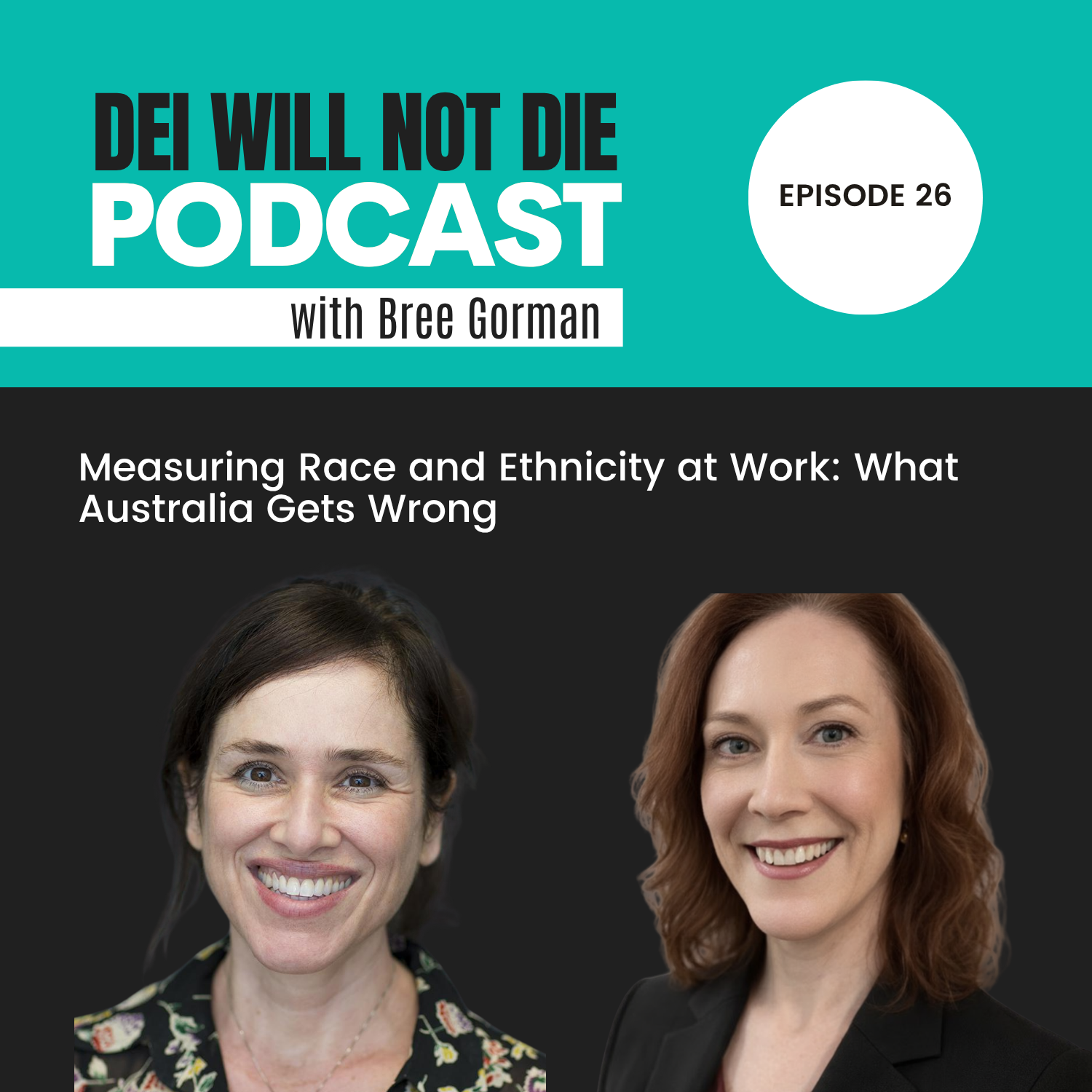
Measuring Race and Ethnicity at Work: What Australia Gets Wrong
About this Episode
Australia has WGEA, a decades-old gender reporting system for workplaces. It has nothing equivalent for race or ethnicity. In this episode, Bree sits down with Professor Dimitria Groutsis and Professor Jane O'Leary, who've spent fifteen years researching how Australian organisations measure (or avoid measuring) ethno-racial diversity, to unpack why that gap has persisted.
They trace it back to Australia's colonial history and the White Australia policy, and to what came after: a shift toward sanitised language like "New Australians," "non-English speaking background," and "culturally and linguistically diverse," all ways of talking around race rather than naming it directly. Dimitria calls it a branding issue with a much more serious history underneath.
The conversation moves into their framework for measuring diversity properly, built on fifteen years of testing, discarding, and rebuilding questions with real workplaces. They talk through the tension between collecting granular, self-identified data and grouping it in ways that don't flatten people into stereotypes, why the wording of a single survey question can completely change the results (the census religion question is a striking example), and what it would take for Australia to move toward a legally mandated approach to counting race at work, the way gender reporting already works.
What You'll Learn
Why Australia still has no legally mandated system for measuring race or ethnicity at work, despite having one for gender through WGEA
How historical shifts toward sanitised language, like "New Australians" and "culturally and linguistically diverse", have let organisations avoid naming race directly
Why the guests describe diversity measurement as a "knowledge production problem" rather than a measurement problem, and what that distinction changes in practice
How the wording of a single survey question can significantly shift the data it produces
The difference between granular, self-identified data and grouped reporting categories, and how to use both without flattening people into stereotypes
Practical advice for HR and DEI practitioners on collecting and reporting ethno-racial data in a way that builds trust rather than eroding it
What a five-year future could look like if Australia moved toward legally mandated race and ethnicity reporting
Resources Mentioned
Keep Learning & Connect With Bree
Want practical strategies for navigating resistance and building real momentum in your DEI work? Access my free webinar on evidence-based DEI strategies here. It’s packed with tools you can start using today.
If this episode sparked ideas or questions and you want to talk more about how I can support your team or organisation, book a free 20-minute call with me. I’d love to hear what you’re working on and explore how we can move the work forward together.
And don’t forget to subscribe to my newsletter for fresh insights, events, and tools to support your inclusion journey. Because real change doesn’t happen in silence.
-
Bree: Well, hello from a very foggy and misty morning on Wadawurrung Country. I want to start today's podcast by acknowledging that I live, work and play on Wadawurrung Country. It's a privilege to do that, and I recognise that this land was, is and always will be Wadawurrung land. I pay my respects to elders past and present, and a call out to any Aboriginal and Torres Strait Islanders who are listening to the podcast, and also to First Nations people across the globe: I've been receiving some feedback from previous episodes, so thank you for joining us.
Today's conversation is going to get into some intricacies about data, which many of you who know me know is a bit of a passion area of mine. I'm a former analytical chemist, so data has followed me. I was very excited when I read a paper that recently came out speaking to the topic we're going to talk about today, but I'll let our guests introduce that themselves. First, let's find out who we're talking to. Dimitria, did you want to introduce yourself to the audience?
Dimitria: Sure, thanks Bree. Hi everyone, my name is Dimitria Groutsis. I'm Professor of Diversity, Equity and Inclusion at the University of Sydney Business School, and I'm also the Academic Director of the Science in Australia Gender Equity Program at the University of Sydney. I'm coming in from Gadigal land today, unceded Gadigal land, and my pronouns are she/her.
Bree: Awesome. And we've also got Jane with us.
Jane: Hi, Jane O'Leary. I'm Professor and Research Director at the Centre for Indigenous People and Work at the University of Technology Sydney, and I'm joining you from beautiful Yugara Country up on the outer edge of Brisbane. My pronouns are she/her.
Bree: Awesome, thank you so much for coming along. I mentioned that you released some research I got really interested in, but I've followed both of your work for a while, so I'll put a note out there for listeners: there'll be some resources in the show notes so you can find all the great work these two have done in our space.
I wanted to start with this: we know that Australia has had WGEA (for those unfamiliar, it's been a gender reporting system for organisations of a certain size across the country), and it's a quite embedded program now. It's been quite binary in nature. But what hasn't been around in this country at all is really something that measures race, ethnicity, or looks deeply into cultural diversity and the experiences of people in workplaces. The US, by contrast, has been measuring race in workplaces for a long time; the DEI work there has very much been focused around that, and we know where things are for DEI in that country at the moment. But I'm interested in talking about why we think Australia has lagged behind in this area, over the years and still currently.
Dimitria: Yeah, thank you, that's a good opening question to set the context. We've had a really uncomfortable relationship with race for a very long time: post-colonial history, and then the White Australia policy, which led to waves of migration focusing on race as a criterion for migration. That wasn't dismantled until the multicultural policy came into play.
Symptomatically, at the same time the multicultural policy came into play, language started being sanitised. Ironically, even though race was removed as a criterion, we started seeing waves of migration being called "New Australians", or "non-English speaking background", or "culturally and linguistically diverse", or "culturally diverse". We used a whole lot of euphemisms for race, and that has perpetuated this idea of calling it something else, not race. That's continued to be a product of our history: it's never really been counted or measured, it's always been an informal, voluntary approach to measuring race and cultural diversity.
I think the work we've done has really highlighted that a lot of this is because we've skirted around what we're actually looking at. It's become a bit of a whack-a-mole situation: what exactly are we looking at? As a result, we haven't been able to ask meaningful questions that capture what we're looking at. There's no consensus, and that's a product of the discomfort around race, and around what we're actually looking at.
Looping back to that, I think the legacy of our history is a fear of talking about race, of being stigmatised by race, because it was always such a negative thing. I think that's lasted: people don't want to talk about who they are, what their race is, because they feel it might be countered, or there might be implications, a penalty. So I think there's a lot of work for us to do. It's almost like race has a branding issue, but on a more serious note, it's also a historical legacy.
I also think there's a lot to answer for in the lack of a legally mandated approach. If you think about the US, they have EEO (Equal Employment Opportunity) reporting, and affirmative action case law that makes it compulsory to capture race. It's not done perfectly, but it is done.
Jane: I wanted to pick up on one thing Dee said, about this discomfort with race. I think many Australians, particularly people like myself (white people), believe the most respectful and fair way to approach race in Australia is to simply ignore it. We hear that when people say, "I don't see race or colour, I just see people, and I treat everyone the same." That's well intended, but when we ignore someone's race, we also ignore the racism they may be subjected to.
A white Australian like me, just through the random birth lottery, has racial advantages from being born white in a white-majority country. Conversely, an Aboriginal or Torres Strait Islander person is born into racial disadvantage just because they happen to be born Black in a colonised, white-majority country. To ignore this reality is to ignore who we are as a nation. So I think often people think of this topic, measuring diversity and inclusion or ethno-racial diversity, as a bit of a dry issue, but actually it goes to the very heart of our national identity, and which parts of this we're prepared to face.
I did want to add, from a purely pragmatic perspective, there's another contributing factor to why we've been slow to measure this nationally: our ethno-racial and cultural identities are often really complex. If you just think of an employee who might be born in Australia, have Lebanese ancestry, speak English, Arabic and French, and identify as Christian: all of that is relevant to that employee's experience of workplace inclusion. Many employers are understandably really worried about getting it wrong. They want to make sure any approach they take honours and respects our national history, because we can't lift and shift from the US or the UK. We need an approach that speaks to our national history, and that employees experience as respectful of their identities. I think that's why, collectively, we've been a bit slow as a nation to lean into this.
Bree: What you've both raised taps into so many of my experiences doing this DEI work and trying to elevate the experiences of people of different races, ethnicities and languages within Australian workplaces. At each organisation I get to, it is, as you've described, complex, and there are really different voices within the organisation advocating for different ways for people to be counted, for the DEI work to tackle this area and not just sit with gender or LGBTIQA+ inclusion, which I think for many workplaces feels easier.
What I loved about the work you've done is that it recognises the complexity but also provides some guidance around what organisations can do. I wanted to get you to describe a little of the work you've done, not in detail, but just to give us an idea of what we're bringing to the conversation.
Jane: Dimitria, do you want me to do a quick summary of the work?
Dimitria: Yeah.
Jane: Dimitria and I have actually worked on this since 2010, which speaks to how complex this whole area is. We started off working with four employers back then, piloting our survey that measured multiple aspects of cultural background, as we referred to it then. We've worked together on it for the past fifteen years, and this paper you saw, Bree, is the latest iteration of our thinking and our approach.
Dimitria: The work has also transformed over time. There have been conversations throughout this fifteen-year period where we've thought, "yes, now we've nailed it, we've got really clear questions", and then we go out to the community and it turns everything on its head. We do a lot of consulting: we've worked with expert panels, people who work in this field, and without bringing in everyone, we don't really capture what we need to capture. That's what this work has shown us: getting out there and speaking with workers, finding out their lived experience, how they self-identify, how others identify them.
We've found in our work that this is a really good proxy of inclusion and exclusion, rather than, say, country of birth or languages spoken at home: thinking about how people are positioned within the organisation when this data is grouped. That's another layer of complexity in how we've built our thinking over time. So it's arrived where it's arrived because we've been churning for a long time. It's not something we baked earlier.
Jane: It's interesting, actually, as a practical example: on the back of the global amplification of the Black Lives Matter movement, all of a sudden employers were saying to us, "hang on, we need to talk about race now. We know we didn't want to before, but now we're ready. How are we going to measure it?"
We did a project in 2020 where we consulted with a lot of people about the use of race-based language, in particular the word "people of colour". It was interesting: in 2010, for instance, we found we couldn't in good faith recommend employers use that language in surveys at that point in time, because when we asked employees who thought of themselves as a person of colour and who didn't, we found that, for example, about half of people with an Asian cultural background did think of themselves that way, and half didn't. I actually think, five years on, if we did that now, the results would be very different.
Another example: ten years ago, we measured how many workers identified with more than one ethnicity, and only 30% did. A few years ago we repeated it, and 70% did. That's what we mean about this field changing, and why coming up with a nationally standardised approach is difficult when things are moving so rapidly.
Bree: That's excellent context, and it certainly confirms the ways I've seen the conversation develop, and what people are comfortable identifying as, and what questions they see themselves in, but also then what we, as DEI practitioners, can use on the other end, which is such an interesting balance that I thought you brought out in your paper.
You called diversity accounting a knowledge production problem, not just a measurement problem. What's the difference, and why does that distinction matter for how HR or DEI teams should think about the data they're collecting?
Dimitria: We love this question, and we love that you got so caught up in the weeds of the paper.
Bree: I did, I did.
Dimitria: It's brilliant. I suppose a measurement problem assumes there's a real, stable thing out there, like ethnic diversity, and we can measure it very clearly: get the question right, get the reporting components right, and you've solved the puzzle. That's a measurement problem.
The knowledge production problem leans heavily on critical accounting literature and the insights from that world, because what it's saying is that what we count, what we measure, creates visibility for a group or an issue, and also allows us to create actions to attend to the gaps. That's what a knowledge production framing does: it doesn't assume the process of collecting or measuring data is neutral, or that it's a black box housing some pre-existing truth. That's significant for us, particularly in this very complex terrain. It allows us to put on a more complex thinking cap, to really question what we're looking at, how we're looking at it, why it matters, where the gaps are, what the actions are. It's allowing us to ask those questions, whereas a measurement problem sees stability, sees something as fixed. This isn't. It's constantly changing, and that's what our conversation has brought out.
Jane: Something I'll pick up on that Dee mentioned: we often think of data as being neutral and objective, just reflecting the reality that's out there. But something as simple as changing the wording of a question can fundamentally change the results. A really good example, which is very timely, is the religion question in the census. I don't know if you've seen the coverage of this, but some researchers found that when Australians were asked the traditional census question, "what is your religion?", 43% selected no religion. When they changed the wording to first ask, "do you have a religion?", the number of people who said they had no religion jumped from 43% to 54%.
The only thing that changed was the question. The reason for that is: if you're asked "what is your religion?", it assumes you are religious, and then you're presented with a list of religions, so you might turn to your family, background or cultural heritage and tick the religion you grew up with, even if it doesn't have relevance to you today. But if you're first asked whether you actually have a religion, you're more likely to reflect on whether you're religious at all. That's why we say diversity measurement is a knowledge production problem: the way we ask questions doesn't just measure reality, it actually shapes the reality that shows up in the data.
Bree: That's so fascinating, and such an important thing to remember when we're putting these surveys together, and also when we're analysing the data that comes through. I've really seen that so much of the work in actually collecting information about people's demographics, identities or lived experiences happens before they're even asked: why are we collecting this data, what are we going to do with it, what have we done in the past when we've asked this type of information? It's a much more complex thing than just sending out some questions and getting people to respond.
I've got another question here, and my brain has forgotten where it went, so I'm going to just read it out. You're upfront in your paper that grouping data for reporting can flatten within-group difference and slide into stereotyping. I think DEI practitioners listening in would absolutely have found themselves in this position before. And yet we need to group the data to make it usable. There's always this tension when we're analysing data, particularly around racial differences and ethnicities: how do we even begin to group the data? And let's be honest, in the Australian context, a lot of the DEI folk doing this work, me included, and those listening in, are white folk, and that adds a layer of complexity and uncertainty about what we should be doing with this information.
We could have a whole episode about why it's not okay that so many of us are white doing this work, and what we need to do about that. My question: what's your advice for DEI and People and Culture folk who are grappling with the tension of wanting to make the data usable, in a way that convinces leadership to do something different and create more inclusive workplaces, while at the same time not wanting to slip into groupings that don't make sense within people's lived experience?
Dimitria: This question picks up on some of what we've already discussed, but teases it out a bit more and brings it to a practical level. For us, there should be some sort of reporting architecture that sits there and is periodically examined, because I think we send out these questions and then leave them out there in the ether: a bit like the measurement problem we were talking about before. It should be periodically examined.
But in the first instance, how do we do that? Collecting data at the granular level is the most important thing to do, and then group it. Ultimately, what we'd love to see is people self-identifying, and also mentioning how they're perceived, based on things like name, accent, religion. As I said earlier, they're great ways of explaining and understanding inclusion and exclusion. But you can't really put that data into a diversity dashboard as is: I can be Greek, speak the Greek language, and also Australian, and it's very difficult to group that neatly.
But if that granular-level data is collected, we can then set up the grouping. Our first advice is to collect self-identifying data, and then group it into broader groupings. This is where the next layer becomes a little tricky, because we'd like those groupings, as DEI practitioners, to have meaning for the people they represent. This needs to be communicated very clearly: a category like "Southeast Asian" may mean nothing to particular groups, it may feel like erasure. Groupings like "European" or "Asian" tend to feel isolating for many people, like they're being erased.
It also depends on why you're collecting the data, the privacy issues around it, and how you communicate why you're collecting it and what the purposes are: who's going to see it, who's going to have access to it. If you're doing it at too granular a level, you're identifying particular people in the organisation. So it's a tension, a delicate dance around how you group the data. Communicating the reason for how you're collecting it, how you're grouping it, and why, is particularly important, and revisiting that periodically, rather than keeping it a static process.
Jane: I often say to employers, as Dee said, start at the most granular level. If you're collecting ethnicity, it might be at the level of Maori, Shona, Malay or Chinese: that level of granularity, so people feel their identity is seen and respected. Then, as Dee said, you can ladder up and aggregate into broader groupings, which gives you great flexibility in how you report on diversity.
The next thing I always say is: report in multiple ways. A lot of employers overlook this. People, when they fill in these surveys, want to see the richness of the data fed back to them. I usually say start by reporting at a really granular level: you might say, "in our workforce we have 150 different ethnicities represented, and the top five most common ethnicities are English, Australian, Irish, Scottish and Chinese", similar to the top five in the general Australian community. You start at that level, and then ladder up into broader categories, as Dimitria mentioned, like Northern European versus South Asian versus Northeast Asian. These categories don't speak to people's identity as directly, but what they do is show major diversity fault lines in terms of people's experience of inclusion at work, so they're really powerful metrics from that perspective.
The last thing I always say is: use this as an educational opportunity. Instead of having it just sit within HR, get internal stakeholders together from across the business, sit down with them, and co-design the whole thing from the get-go. They'll then be your biggest champions out in the workforce, explaining how the data is being used, why it's important to collect, and why a particular approach is being taken and not another.
Bree: That's such great advice, and it reminds me of a project I was doing with a big multinational organisation that had six to eight different employee resource groups, and a survey they'd run in the past with varying levels of engagement. The approach this time was to actually engage all the co-chairs of those working groups to work on the questions. That was a long, arduous process, to be quite frank, but it meant the data that came out at the end was so much richer, because there was so much more engagement across the organisation with the survey itself, and why certain questions were being asked. There was much more a sense of comfort in answering the survey, and what we saw at the end was that the "any further comments" question was actually so much more positive than in previous iterations: people were really grateful to have contributed to the survey, and to see themselves reflected in it. I'd love to push that point forward: engagement with what we're doing matters so much, and the communication of it in ways that employees, not just leadership, feel is useful.
My final question: the framework I'd absolutely encourage all the listeners to check out, because I think it provides great guidance when we're working in this space and considering how to collect data, not just through a survey but through other qualitative instruments too. If this framework actually gets adopted in the way you're hoping, what does a diversity, equity and inclusion action plan look like in five years, that doesn't look like it does now? What would change in the way we're doing the work?
Jane: I love this question, and the reason I love it is because our vision would be for measurement to become central to the action plan, rather than an afterthought. I think, as DEI practitioners, we're often so busy that we're pushed straight to action, to implementing initiatives, usually initiatives our leadership team has come to us about, saying, "our competitor is implementing inclusive leadership training, why aren't we doing this?" They're looking for a silver bullet, and we're pushed into a silver-bullet approach to initiatives.
What I'd like to see is: flip the script, put measurement at the centre, understand the state of play, set an aspirational or future state we're trying to work towards, and introduce initiatives that will enable us to achieve that. I'd also say it'll help us move towards making intersectional measurement standard practice, rather than an occasional afterthought.
I did want to do a call-out to Chief Executive Women, because they invited Dimitria and myself to work with them this year, so that for the first time their census on senior executive women in ASX 300 companies will have an ethno-racial lens applied to it. So we are moving, progress is happening. I'll pass to Dee.
Dimitria: I totally agree, and I'd add: I actually love this question too, because it allows us to think about what's possible. What would be the Willy Wonka of this space in five years' time? A legally mandated approach to counting ethno-racial diversity, like a WGEA-mandated approach. What we found in our research is that legally mandated approaches have much more success, not necessarily in shifting the dial (that happens too), but in getting things done, socialising people around the language, why we need to do it, and lifting visibility.
We also keep having these conversations about leadership and setting targets, but we can't really set targets unless we're asking meaningful questions and collecting meaningful data, and understanding what that whole lifecycle looks like. So I think, at the heart of it, we'd love to see a sector-wide, legally mandated (if possible) approach to collecting, measuring and reporting on this data. That would be great.
Bree: Wow, love it. You're speaking to my heart, both of you. This has been such a wonderful conversation for me. I say to many of my friends that doing this podcast is my professional development: I'm learning so much, and I know the audience is too. So thank you so much for sharing your knowledge and approach with us. As I said, I'll put some links in the show notes for people to read more and learn more, so we can really lift the practices we're doing in this space, across this country and hopefully in others too. Thank you both for coming on, and thank you everybody for listening. We'll catch you on the next one.
Jane: Thanks, Bree.
Dimitria: Thanks, Bree. Bye.