
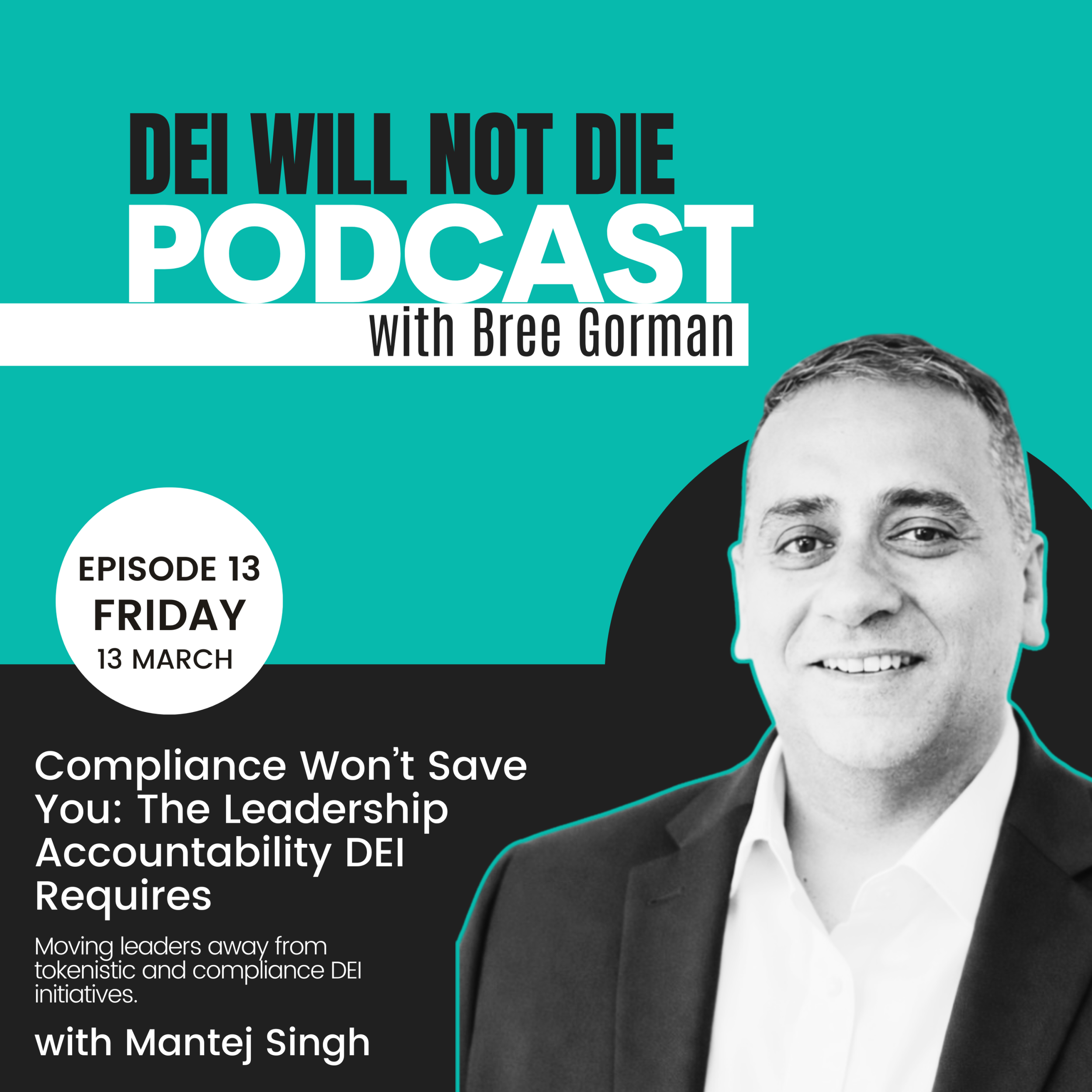
Episode #13
Compliance Won’t Save You: The Leadership Accountability DEI Requires
About This Episode
In this episode of DEI Will Not DIE, Dr Bree Gorman is joined by Belonging and Inclusion Strategist and Founder of Belonging Co, Mantej Singh, to explore how leaders can move beyond tokenistic, compliance-driven approaches to DEI at work.
Together, Bree and Mantej unpack what leadership really requires when it comes to diversity, inclusion, and belonging. Mantej shares his perspective on bias, racism, and anti-racism in the workplace, and challenges the idea that leaders need to be “experts” in everything. Instead, he invites leaders to take a proactive role in listening to lived experience, resourcing change properly, and embedding inclusion into the core business, not treating it as a tick-the-box initiative.
From naming the barriers that stall progress to defining what anti-racism actually looks like, this episode is a grounded and practical conversation for leaders who are ready to move the needle.
What You'll Learn
● The seven barriers that Mantej believes prevent leaders and organisations from embracing inclusion in every system of the workplace.
● Why leaders should never consider themselves ‘experts’ in DEI, and why lived experience plays a crucial role in the implementation of DEI initiatives.
● A deeper understanding of what anti-racism means in the workplace and what actions leaders can take when racism occurs.
Resources Mentioned
● Build inclusive workplaces where everyone can thrive: Inclusive Leadership workshop
Keep Learning & Connect With Bree
Want practical strategies for navigating resistance and building real momentum in your DEI work? Access my free webinar on evidence-based DEI strategies here. It’s packed with tools you can start using today.
If this episode sparked ideas or questions and you want to talk more about how I can support your team or organisation, book a free 20-minute call with me. I’d love to hear what you’re working on and explore how we can move the work forward—together.
And don’t forget to subscribe to my newsletter for fresh insights, events, and tools to support your inclusion journey. Because real change doesn’t happen in silence.
-
[00:00:00] Is DEI dead? Not even close. I'm Bree Gorman and this is DEI will not die the podcast for people doing the real work of inclusion. Whether you are leading a team shaping DEI strategy or just trying to make change that lasts. You're in the right place. We will cut through the fluff and dig into practical insights that will help you lead with clarity, courage, and impact.
Want more tools and support? Head to breegorman.com.
Hello and welcome, and I am coming in to the podcast again from Wadderang Country, the land that I get to live, work, and play on. It's Bree, your host, and I'm really enjoying the role of podcast hosts at the moment, but do wanna acknowledge that the land that I live on, work and play on [00:01:00] always was and always will be Aboriginal land.
This is season two, right? We're into season two of the podcast, and I made a big blooper and I didn't have my audio working correctly when we first tried to record this episode. So my guest has been incredibly gracious to come back on to repeat the conversation. We'll probably have a very different conversation to the one you will never hear, but that's okay.
We're gonna talk about DEI and leadership and all things surrounding that topic, and I'm really kind of happy to be able to talk to you Mantej and discuss some of the things that we'll probably get to today, but we should put a moment in time. We are both cricket parents. Yes, this cricket season.
So I hear there's some good news in your family in terms of making finals as well. Yes, yes. My son has been in the semifinal cricket. Unfortunately, I was watching late, so my son progressed. And, I was watching the [00:02:00] cricket match between India and South Africa last night, which India lost, which obviously is not great.
But, it's great cricket matches and I think, as cricket parents, cricket is a great sense for inclusion and belonging sport in general. Mm. And I think it brings people together and, certainly coming from an Indian background, it's, part of the DNA. Yeah, absolutely, and, I was thinking too around the, you know, the time of the year and how cricket kind of does consume our lives for a while.
For those who don't know what cricket is, if you are listening from other countries that don't play cricket, or even if you're in Australia and you're not a Cricket fan, it is a sport that, if you're not involved in, can be seen as really quite boring 'cause it is longer than many other sports. But for those of us who are involved and love the sport, we love that it takes longer.
So it gives us more cricket, but it's a busy time of year. And good to hear there's been some success in, your family. But before we go on, I better give you the opportunity to introduce yourself and tell us a bit about [00:03:00] what you do and what you get out of the work that you do. Thanks Bree, for everyone.
My Hello. My name is Mantej Singh, i'm the founder and director of Belonging Co, which is a social and cultural inclusion consultancy that works with leaders, both CEOs to help them drive inclusion and belonging outcomes, but from a social and cultural inclusion lens. And in particular to identify barriers and the role of leaders in driving inclusion and belonging.
I have set up this consultancy about 10 months ago after a social impact fellowship, but prior to that I worked in government in various roles, managing diversity and inclusion, community engagement, social outcome functions across many different kinds of organisations. Really enjoy this work, it gives me a great sense of pleasure, but what I enjoy most is working with leaders.
Communities to drive genuine inclusion and belonging outcomes that have a business impact that are not just. Tick a box or compliance focus, but actually shift [00:04:00] behavior, produce better outcomes, and make organisations that leader better for embodying inclusion and belonging in their approach. Mm. I'd love us to kind of start there.
This is one of the, I think, most repeated questions. That I get either through the social platforms or in conversation, is how do you actually get leaders, to move from a kind of tokenistic, as you say, tick boxing type attitude into really engaging and meaningfully driving the DEI work that we're doing.
It's a great question, Bree. How, uh, how can we sort of leaders really take charge of this work? I think before you take charge of something, you've gotta understand what blocks it, what prevents it, what stops it from occuring. Mm-hmm. And what I've identified is there are seven key barriers to organsations and leaders taking inclusion work and belonging work seriously.
And these barriers for me are firstly an HR only mindset. So if you [00:05:00] think the inclusion is the work of human resources. That mindset can limit you to very sort of constrained, compliant based outcomes. So we need to expand that to business impact mindset. The second barrier is compliance mindset, where we say we've gotta do a diversity action plan, we've gotta do a policy, and we take that box and we are done.
We focus on the output of that action, but we don't actually look at what do we need to do to implement it, to circulate it to socialises in our organsations. The third barrier I would call is a risk mindset. Where you just look at inclusion from the lens of risk and you say, well, what risk is gonna create for us?
And so we're gonna address it that so you're not actually taking inclusion in a holistic way. And the other four barriers, Bree, are delegation mindset where you delegate inclusion work to someone else in the organisation so you're not able to take ownership of it. Then is a performance mindset where you can go to a panel discussion, where you can write a [00:06:00] newsletter and say, we really value inclusion, but then it actually takes to allocating resources or standing up for something.
Taking a stand on a particular issue, you sort of hold back and the six one is scarcity mindset. So we say if you have to do inclusion and belonging or diversity, inclusion and belonging, then you've gotta take resources from somewhere else, and resources are short. Whereas what should happen is that diversity and inclusion and belonging should be embedded into all of the work that we do.
Not a separate thing, not an add-on thing. And the last one, which really goes to what you're ans uh, what you were asking is, is the leader, expert mindset. A leader, expert mindset is where we assume that leaders are experts in diversity, inclusion, and belonging, like they're experts in everything else, but inclusion and diversity, inclusion and belonging, anti-racism, multicultural outcomes, disability.
This is years of lived experience for some people, Years of living barriers, systemic barriers, interpersonal barriers, and knowing what needs to [00:07:00] systemically change to address those barriers. So leader, any leader, cannot be an expert in all these areas. Mm-hmm. Especially when you don't have lived experience.
So I think leaders need to be more consultative, more engaging, listening to feedback, suggestions, and actually suspending judgment and opinion to actually listen to people with lived experience and to see what needs to happen and their role of leader should be. To find the resources, address the barriers that I've identified, and actually help move real action, tangible action on the ground that moves the needle.
And what I mean by moving the needle is people can actually see a difference on the ground. Mm-hmm. But the rest is all theater, you know, policy or the action plans. But if people on the ground don't see the difference or feel the difference, then the work actually is not occurring. There's lots of busyness.
There's real movement and action on the ground. Mm. I really wanna pick out that point around. [00:08:00] That leadership expert, last one there, because I think there's two things that can happen, right? There's, well, there's more than two, but two of the things that can happen is leaders can be so fearful of getting it wrong and not knowing enough that people think that they have to have all the answers, that they therefore do nothing.
Because they're too afraid to step in or they, like many other people think that everybody's an expert in DEI and they just go and do stuff without doing that listening piece. So I love the way you've kind of worded that around. Encouraging leaders to stop and listen, suspend their judgment. They don't have to have all the answers, but they do have to, I guess, be the drivers of that action piece.
Hmm. Can you talk more a bit to that in terms of how leaders can move into that, move away from this? You know, I have to be the expert to that more facilitation role, I guess. I think the, it's a great point, Bree, and as you've said, [00:09:00] what what is really important is because DEI work. Everybody can have lots of opinions about what's right and wrong about DEI.
There's a, there's a global, geopolitical environment in which DEI is operating in today's time. There's lots of opinions, some people think that this is really mission critical. DEI has to stand and that's gonna save everything, and some people think DEI is quite bad and it's sort of harmful. So when we have such a divided geopolitical social climate across the world in Australia, sometimes you can get caught in that.
And flow with that. And that means that we are always shape shifting, narrative shifting to what is the sociopolitical capital in today? Mm. And DEI is a values based field. It's about human beings. The negative impact they are experiencing due to diversity background. They come from the systemic disadvantages and barriers they're facing.
And if leaders have not experienced that, they really don't have a way of telling, how much [00:10:00] impact something is happening. And if you always in the rate shift with what's happening geopolitically, it can really impact because there's no stable ground for DEI then there is no value based engagement, there is no value based listening.
We're always moving and the rights and wrongs are always shifting. So to answer your question, the way leaders can address this is firstly to accept that they don't have to be experts. That they are not experts in everything, especially from a lived experience perspective, and then combine that with, they have an accountability to build inclusive organsations
The more bigger your organisation, especially in the government sector, you have more responsibility and accountability to provide services inclusively for the wider community and public as well. Mm-hmm. So it's not just about compliance. Mm-hmm. Government exists to serve the community we represent, and the community is diverse.
Once leaders take all these factors into account and they go into a diversity and inclusion conversation, [00:11:00] they have to take all of this in there, that they have a role, but they don't know everything. And it's a dichotomy, right? Because we expect leaders should know everything. Yeah, so they've gotta take that in, that I need to play this role.
I need to take accountability and accept the fact that I don't know everything. So I will build that capability through listening to understanding what works and what doesn't work. And sometimes that may not aligned with what I think is right and wrong, and that requires a level of humility and that requires a level of not, I wouldn't say it's accepting risk, but it's respecting people.
Mm. I think it gets, uh, mentioned as that you leaders have to accept the risk of, it could go any which way, but it's more about leaders have to have the humility to respect experiences that are different from them. Mm. And then be genuine about that. Acknowledge it, and sometimes you have, you can say, well, we can't do everything, but it's still very important to acknowledge what must be done.
Mm. And [00:12:00] then say that to acknowledge barriers, to acknowledge what needs to happen. And then you can say, we can't do all of it. But that acknowledgement, that pause, that humility, and then having some grace around how they go about making that change, communicating to an organisation, to the community is really important.
So these are really, the words that I'm using are grace, value, humility, listening, judgment as sort of the ingredients of inclusion, isn't it, Bree? And absolutely. Part of it is when we recruit executive leaders or senior leaders or CEOs. We should be asking those questions through an interview or an executive search process, and then only we can get that.
Absolutely, I have often advocated for this, and some people look very strange at you when you try to say, well, you know, have you included inclusive leadership as a key selection criteria that you're assessing people against it? It's very important. Otherwise, we are asking people to do things that they don't naturally [00:13:00] inherently do.
Anyway, which is kind of, as you say, if the values aren't aligned, it's much harder to get a leader to act in this way, than if they come from that shared values perspective. I'm interested to talk, I know you've done a fair bit of work in the anti-racism space and we know. You? Well, I think from what I've observed in DEI circles in this country, in Australia, DEI practitioners and leaders have been even more fearful, I think, of working in the anti-racism space or.
Cultural diversity space, and you know, let's be honest, most leaders in this country are still white, and so there has been a level of discomfort and a lack of power around. You know, how we can bring some of the focus of the DEI work onto cultural inclusion and also anti-racism. We're seeing a little bit of a moment.
I think at least I'm seeing a bit of a moment. We saw the release of the report last week around racism in Australian [00:14:00] universities, which is a very hard hitting report, and we're seeing unfortunately. Some really awful dialogue from some politicians at the moment too, that has really brought racism, I think, into the conversation perhaps more than it has been in the past in this country.
I'm not sure, i'm interested in your perspectives. What do you think this means for people doing DEI work doing anti-racism work within their organisations currently. I think times are, are challenging. We should firstly acknowledge that, and again, it goes into the global DEI backlash in general.
Mm-hmm. But I think what's really important is that firstly we have to identify what is anti-racism and what's racism. Racism is, firstly, I think we have a lot of guilt in Australia around racism 'cause of our history with colonialism, treatment of aboriginal people, increasing multiculturalism, migration and what has happened in recent times.
But firstly, racism is a global phenomena. It's not just an Australian [00:15:00] thing, so we don't have to be really too guilty about it in as a society. It exists everywhere. But what we must do is to understand it, to acknowledge it at, and it's the lack of trying not to acknowledge it is the issue. It's not the fact that racism, a lot of people with diverse backgrounds, with majority and minority, and it's almost a majority and a minority issue, rather than just purely a racism issue.
And, it's global, but we also have it there and therefore, as a result. And essentially what it , is people being treated differently in workplaces, in communities and public spaces because of their race. So the color of your skin, the country you come from, the religion you have, and sometimes it's a combination of all those things.
So it does occur whether we acknowledge it or not. Many times it's unconscious, many times it's conscious. Obviously racism is illegal, no decisions can be influenced by a racist mindset. What anti-racism, especially in the context of DEI Bree, means that we are going to do [00:16:00] everything possible as leaders, as colleagues, to not let racism flourish.
So that's a proactive stance, it's not saying I won't do it, that no longer is good enough. It means that as a leader, as an executive, I will ensure that, have awareness training. I will have dialogue, discussion policies. That prevent racism from occuring that make people aware of what is racism. The racial literacy of the organisation is high, and so it doesn't occur.
But when it does occur, we will call it out, and then when, when it does occur, we will support staff that face racist experiences. And sometimes we think racism as this very loaded word and people sort of say, well, it doesn't occur. Or people wanna sort of stay away from it, but more simpler word is bias, which is the same thing.
Word it differently, we all have biases, so racism is a bias in a cultural context. We have biases towards people with disability, which is ableism. We have biases toward other diversity dimensions, so bias [00:17:00] exists and we all must work toward racism. So when I've been working with executive leaders around racism and anti-racism, the biggest thing I've identified is that it's, again, that what we were talking earlier is the ability to acknowledge.
Be humble, listening. Be graceful about the discussion, acknowledging your own privilege, but then committing to real action, which can be felt on the ground. Mm-hmm. And I think that is really important, and sometimes we think, oh, well this racism is this very big thing. Something specific has to happen, but it's quite common on a daily basis as well.
So things like mispronunciation names, not checking, referring to decisions using these people. And those people have poor English equating accent with competence and credibility or, you know, the way we design services, designed not with sort of diverse representation taken into mind. So these are all examples of bias, lack of engagement or not, including everybody, [00:18:00] and sometimes at the back of these things is racism, bias, and privilege.
And so then if you were a leader in an organisation currently that hasn't really done anything in this space yet, where can they start? There's no perfect way to start, all organisations are different there, so there's not a cookie cutter approach. The first thing is to engage a good diversity and inclusion or a anti-racism consultant.
You can engage me, you can engage anybody else in the sector as well. There are lots of great people working in this space. To do an audit of your workplace culture the way programs and services are designed, customer service, the way you conduct engagement, and actually identify where the problems are.
Mm-hmm. Because those problems are gonna be different for each organisation. Then the seven barriers that I designed earlier, spoke earlier about think where, how are they playing up in the organisation. So you can call that a belonging audit or a barrier audit. It. And then from there, work out a strategy of [00:19:00] how you are going to address those barriers.
So that requires having an anti-racism strategy or a cultural action strategy, or a diversity action plan. Whatever name you want to give it, but create a specific set of actions of how you are going to drive change against those barriers over a stipulated period of time. Mm-hmm. And then as the leader of an organisation or a senior executive own it.
Publicly in the organisation publicly, if you can do it in the community and say, I will make this happen. Mm-hmm. And I commit to this change, and I think that public acknowledgement, public accountability that needs to be matched by allocating resources, achieve those actions. Because if you don't allocate resources, that could be funding, that could be directing a part of your organisation like HR or Legal, shift their policy and practice in a certain way, that could be to create a mentorship program.
That would be to create anything that you've identified, when you gotta allocate resources, your own time, and your own [00:20:00] credibility and commitment to facilitating that change as a leader. What a great roadmap and you know what a great roadmap really for most DEI most DEI work that we're doing., Yeah. I love it.
Excellent. We will make sure we put in the show notes how people can get in contact with you and hear more from you. I've really enjoyed your LinkedIn post, so that's a plug. We'll make sure we put your link to your LinkedIn profile as well. 'cause I've really enjoyed the conversations that you're having there and the stuff that you're, that you're putting out.
But thank you for having this conversation twice with me. I think it's the life of dealing with ADHD and, technology, right, and the combination of those things. But we got there. Yeah. Can I add one more thing, Bree? Yeah, definitely. Yeah. So I think many times, one of the things that I've identified is when we and I speak to people about racism and bias and cultural diversity engagement, assume that I, you suggesting that [00:21:00] people from diverse backgrounds that come from other countries or of different ethnicities or religions, they have a culture and people in Australia don't have a culture that is not the foundation of this work.
We all have a culture, but we are not all discriminated on the basis of culture. Mm-hmm. And our religions and ethnicity. So I think that's the difference. Mm-hmm. And sometimes people get concerned by words like privilege that, you know, we all have some privileges and we all have some disadvantages, true.
But we, the lack of privilege, you don't feel if you, if you're not impacted because of race. Hmm. So it's not to say that everybody who is not culturally diverse. It's more to say that everybody who's not culturally diverse needs to understand and acknowledge that lack cultural diversity does impact racism and bias.
Not everybody does it, but we all have a collective role in society to be aware of this and to stand. To have an anti-racist mindset no [00:22:00] matter where we are in our workplace, in our community, in a park where we are riding a dog or we are, playing cricket on the sports field. Whatever we do, we have a role to play as citizens, and we have a role to play as leaders to be having an anti-racist mindset and calling out prejudice and bias and helping build society where everyone belongs.
I'm glad you did add that bit and, you know, it makes me think of the question that I often get, like, what about straight pride? It's exactly to your point, people aren't being discriminated against because they're straight or heterosexual. And so there's a, reason for the focus and, for, pride events and you know, we're in kind of a pride month here in Australia at the moment, but hearing you articulate that, it's exactly the same thing.
Yes, all of our identities are valid and are wonderful and should be appreciated and acknowledged, and some people also face barriers that others aren't facing [00:23:00] and we need to put words to that and action to that. So yeah, thank you for adding that. It's such a great point. Thanks everyone for listening in.
Hopefully we'll catch you on the next episode. Thanks, Bree, and thank you everyone. Thanks for joining me.
Well, that's it for today's episode of DEI Will Not Die, want more resources and support to do the work? Well, why don't you visit breegorman.com and don't forget to follow or share this episode with someone who cares and maybe also someone who should.