
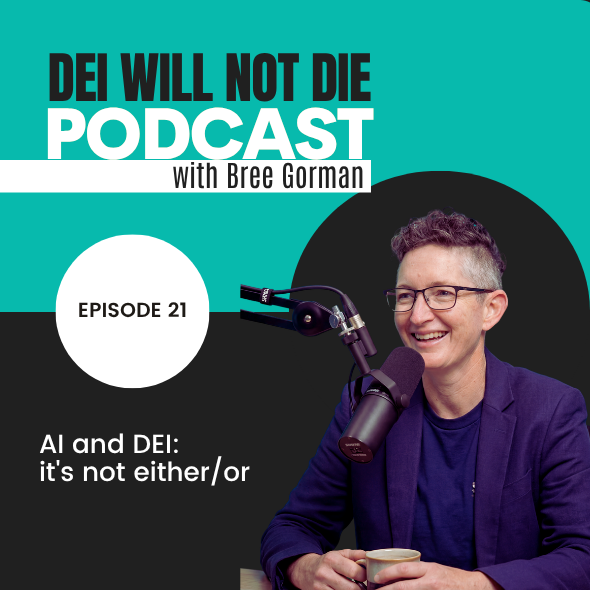
AI and DEI: it's not either/or
About this Episode
In this solo episode of DEI Will Not DIE, Bree Gorman addresses AI through a diversity, equity and inclusion lens, refusing the binary that says AI is either good or bad for inclusion.
Bree explores the real accessibility gains these tools are creating, from speech-to-text becoming more accurate to neurodivergent and multilingual workers being able to communicate on a more level playing field. They challenge hiring managers who reject "AI-looking" cover letters, and share how they use AI in their own work as someone who is ADHD.
Bree then turns to the other side: how AI can amplify the biases of both its users and its developers, what that means for recruitment and promotion, and why the people most exposed to job losses are often those already underrepresented. The throughline is that none of this is automatic. The outcomes depend on who is involved, what gets challenged, and whether organisations design for equity or simply let it happen to them.
What You'll Learn
Why AI isn't good or bad for inclusion, but both at the same time, and why that changes how you respond to it
How AI is lowering communication and accessibility barriers for neurodivergent and multilingual workers
Why rejecting a cover letter for "looking like AI" can screen out genuinely capable people
How biased AI systems can make the humans who use them more biased over time
Practical priorities for DEI and HR leaders: challenging the stigma, designing against bias in recruitment, and supporting people whose roles are most at risk
Resources Mentioned
OECD (2026), AI to Support Neurodivergent Learners in Vocational Education and Training
Glickman & Sharot (2024), How human-AI feedback loops alter human perceptual, emotional and social judgements, Nature Human Behaviour
Keep Learning & Connect With Bree
Want practical strategies for navigating resistance and building real momentum in your DEI work? Access my free webinar on evidence-based DEI strategies here. It’s packed with tools you can start using today.
If this episode sparked ideas or questions and you want to talk more about how I can support your team or organisation, book a free 20-minute call with me. I’d love to hear what you’re working on and explore how we can move the work forward together.
And don’t forget to subscribe to my newsletter for fresh insights, events, and tools to support your inclusion journey. Because real change doesn’t happen in silence.
-
Well, I can say it is absolutely freezing this morning on Wadawurrung Country as I record this episode. I want to pay my respects to Elders past and present, and recognise that this always was and always will be Wadawurrung Country, a country that I have the privilege of working, living and playing on almost every day. It is cold. And I want to talk about a topic that's a bit hot at the moment, well, has been for a while. I felt that it was time to address AI through a diversity, equity and inclusion lens.
We can see that there are some good things happening in this space, but I feel like it's definitely got the potential to get lost in the noise. There are a couple of things I wanted to pull out. The main aspect of this episode for me is that this, like everything in DEI, is not a binary issue. AI is not good for DEI, and it is not bad for DEI. It is actually both of those things happening simultaneously: positive ways in which AI is facilitating equity and creating access, and also ways in which it is amplifying biases and reducing opportunities.
That's where it's tricky. And let's not forget, I've opened with an Acknowledgement of Country, so let's not forget the environmental impacts of AI and the climate change conversation occurring. This is complex. These tools have some real positive impacts. They are creating access and equity where it didn't exist before. But there are some real negative drawbacks to these systems as well. So I want to hold that conversation today, and explore both of those things in a way that's not particularly deep, but hopefully has you thinking about what practical steps you might be able to take to enhance the positive attributes of these systems, and to limit the negative impacts of that amplification of bias that we're seeing, which is absolutely real.
I want to start with the accessibility and equity benefits we're seeing from AI, and these can't be understated. In some of the conversations I've had about AI, particularly in DEI spaces, there's been so much negativity and stigma around the use of AI that we're forgetting the great advantage these tools bring to people who have been excluded from certain ways of communicating for a long time, or certain ways of seeking employment and completing tasks.
So let's think about a report released by the OECD. I'll put the link in the show notes. It was specifically around AI and neurodiversity, and its impact on vocational education and work. One of the key outcomes of that report was clearly that text to speech and speech to text tools have become much more accurate now because of AI, and more accessible. I think this is a great thing. It has the potential, and is already facilitating communication, in a way and for people that perhaps didn't have that access beforehand.
Let's think about people with dyslexia. Let's think about people with different levels of literacy disability, but also cultural nuances and differences around language, and just language in itself: having access to the English language in a way that allows you to be seen as proficient. The number of people who get knocked back at the shortlisting stage because their cover letter wasn't written in this "perfect" (and I say perfect in inverted commas) grammar and use of phrasing. This is a leveller. Somebody who has brilliant skills at a job, but just can't get through the recruitment process, because the recruitment process is creating artificial barriers that don't actually assess whether they'd be great at the job or not.
Now, I have heard, in workshops I've been running, hiring managers say, "I just kick out anyone whose cover letter looks like it was written by AI." And my question is, why? What logical reason would you have for doing that? And they say, "Well, if they can't even write their cover letter." It's not that they can't write their cover letter. It's that this is a barrier we place. We have this idea of what high level communication skills look like, and sometimes there are skills that aren't even required in the job itself. For the majority of people now, when they get into a job, they get to use AI. So eliminating people just because they're using a tool that's available to them, that perhaps helps them overcome a barrier they've faced for their entire working career, that helps level the playing field a bit, I just think is awful. I think it's a very narrow-minded way of looking at the recruitment process, and at people's access to these tools.
For myself, as someone who is ADHD, the use of AI has allowed me to write more polite emails, and to communicate more efficiently and effectively. It allows me to craft arguments, or not even arguments, just points that I'm trying to make, in a much clearer way that can be absorbed by my audience. I do write in the way that I speak, and ideas will come from everywhere, so I will go into an AI tool and dump my thoughts down there of what I want an email to say, and I'll ask it to clarify it, make a clear thread to the argument, highlight my key asks in dot points, and so on. This has increased the effectiveness of my communication, and decreased the trouble I've had in the past, in my case with clients, where my communication hasn't been clear enough, or hasn't been written in a way the audience can absorb most effectively. Now I'm overcoming those communication struggles that I did sometimes have in the past.
I'm not afraid to admit this, and this is not a negative thing. This is me using a tool that is available to me to improve my communication, to improve my projects and the way I service clients. And that is a great thing. So this stigma we're placing around people who use AI to communicate is, I think, really detrimental. It's putting our blinkers on and not allowing us to really access the great benefits that come with having tools like this available to us.
People who are autistic are also using these tools to help them interpret social cues. There are many of us neurodivergent folks who are using it to help put the little social niceties into emails and communications that perhaps we haven't done before, because we don't prioritise it, but that means something to somebody else. And let's also think about the impact this has for people who are thinking in a language very different to what they're having to write in. I can only imagine how challenging that is, and how much more efficient and productive somebody could be if we've now given them a tool that can help them overcome some of the challenges in communicating and doing their work.
So I hope I've made my point, trying to challenge some of those thinkers out there who are just so negative on the use of AI. Now, I understand why it's there. People have been producing slop. People have been looking to cut corners. But I think there's a really large majority of people who are using AI to allow them to be better at their jobs, to improve their communication, and to make them more efficient. I think that's a really positive thing. And what it's doing at the same time is creating equity.
Now, I'll talk about why it also can create some inequity, because who has access to the tools, and to the best tools? We know the free versions are nothing like the paid versions. So we know there's a privilege gap occurring in terms of who has access to the tools, who is investing in these AI tools and going to make a bazillion dollars. We know there's definitely inequity being created as well. But I think there's some positive that we need to take out of it, and I'm just really concerned about some of the stigma and negativity around people's use of these LLMs.
Now, let's talk about how they do amplify bias, because they absolutely do. We know that tools like ChatGPT and others want us to feel good about using them, and so they agree with us. That means our biases get amplified in the process of using one of these tools. And the biases of the people who develop the tools get amplified as well. This is a real problem.
Now, I have found in general that there are some great messages coming through from these tools around what's equitable, how to minimise barriers, the fact that there are barriers in the workplace for people based on their identity, and challenging the idea of the "best person for the job." If you work with these tools around these topics, you'll see that they are drawing on the research and the knowledge that exists, which shows us that biases are real and how they're impacting systems. But the user still needs to be very aware, and able to challenge it when misinterpretations come up and when biases are being amplified. I find that I do that. A lot of my work with AI tools is about noticing the biases that come out in their outputs and challenging that. Once you challenge them, they'll go back and find the right information and improve that output. But if you don't know to challenge, then those biases will just be there, and they will be amplified.
There was a 2024 study published in Nature Human Behaviour that tested over 1,400 participants. Again, I'll put this link in the show notes. What it found is that when humans interact with biased AI systems, they don't just receive biased outputs, they internalise the bias and become more biased themselves over time. One of the examples was as simple as showing people images of a certain profession that were all white men doing this job, and that then increased the bias people had towards white men doing that particular job. It was finance managers, not IT managers, I just checked my notes there. After that exposure to seeing finance managers represented as white men, they were significantly more likely to associate the finance manager role with white men, which is actually not one of our more typical biases. So it can amplify your bias, absolutely.
And we know the problem with AI recruitment tools. We've seen cases being brought, lawsuits being brought in the US. There was one against Workday, for those who are using Workday for their recruitment, because it had systematically excluded people based on age. That had been discovered, and so a class action has been taken against Workday for excluding people at shortlisting based on their age. We know this is happening. If DEI folks, or those who have a deep understanding of equity, are not involved in the selection of these AI tools and the programming of them to work in your recruitment processes, sure, it might simplify your recruitment and make it more efficient, but you're going to miss out on people with great talent. You're also going to set yourselves up for potential lawsuits of discrimination, because it is going to exclude people.
There was another case where one of the AI recruitment tools was routinely excluding women from roles, because it had been trained on the CVs of people who'd had those roles in the past, and they were all men. So of course the AI tool said, right, well, gender is clearly one of the selection criteria I need to be watching. So we absolutely need to be thinking about how we're programming against bias, assuming that the AI has just as much, if not more, bias as the humans doing the recruitment process. We have to put the measures in place to make sure we're overcoming that.
The other point I really want to make in this episode is about something we've heard so much about: the job losses that will occur as AI tools become stronger and more efficient. We know the impact is going to fall the hardest on lower skilled workers and marginalised communities. That's a given, unfortunately. And I look at the roles that are most likely to be replaced, and you know who is holding those roles? Women and people from marginalised and underrepresented communities.
What should we be doing as DEI practitioners when it comes to this? For starters, ensuring that education is being provided around the use of these tools. If we think back, I'm in a town where a predominant employment angle used to be making cars. Manufacturing cars in Australia really is no longer a thing. There was a huge transition period, and I remember it quite clearly, for the whole town, about skill development for those who had been employed by the manufacturing industry, particularly the automotive industry, and how they could shift into different careers. A lot of funding, programs and effort was put into this, noting that this was an industry that was going to be significantly impacted, and people were going to lose their jobs.
I'm not seeing that now. We're not yet doing that, where we recognise, if you look within your organisation, what are the roles that are most likely to be replaced over time with the introduction of AI tools? And what are we doing specifically with those employees to skill them up, to either capitalise on using AI in their roles, or transfer their careers into something else? We need to be proactively doing that. It's very clear which roles we're going to need less of, and it's also very clear which roles are going to be really enhanced by the use of AI tools. So are we training people so they can be the ones who get to capitalise on that advantage? Or are we just letting them walk slowly into unemployment?
So, as DEI practitioners, or as HR leaders and leaders in an organisation, if I was going to sum up some of the things I think we need to be thinking about: yes, we need to really be challenging the stigma that is popping up around the use of AI tools, making it very clear to people what we can use it for, what we can't use it for, and taking into account accessibility and equity when we're doing that. That's one thing. The second thing is identifying where the amplification of biases can be happening within our organisation's use of these tools, particularly when it comes to recruitment and promotion, but also in other ways, in how we're servicing community, clients or customers, whatever that may be. And the third one is realistically thinking about whose jobs are at risk in our organisation with the increased use of AI, and what we're doing to help those people maintain employment or transfer their careers, as we've done with other industries in the past when there have been technological advances.
So there are some of my thoughts on AI. I'm interested in yours, as always. Clearly, from this, you've heard that I do use AI a lot. I have found it has really helped me produce better products and create more thoughtful outputs, and I'm really for that. But I'm also really conscious of the negative implications of these tools as well, and how unsure that feels. For many people, that does feel unsure. So, probably as my passing note: maybe let's think about the health and wellbeing of our employees, and the stress of uncertainty around this change in working practices, and what we're doing as organisations to really support people and create those inclusive environments that we're really hoping to create with this work. I'll catch you on the next episode.