
Ripples of Inclusion: Anti-racism as a gateway with Carrie Sawyer
About this Episode
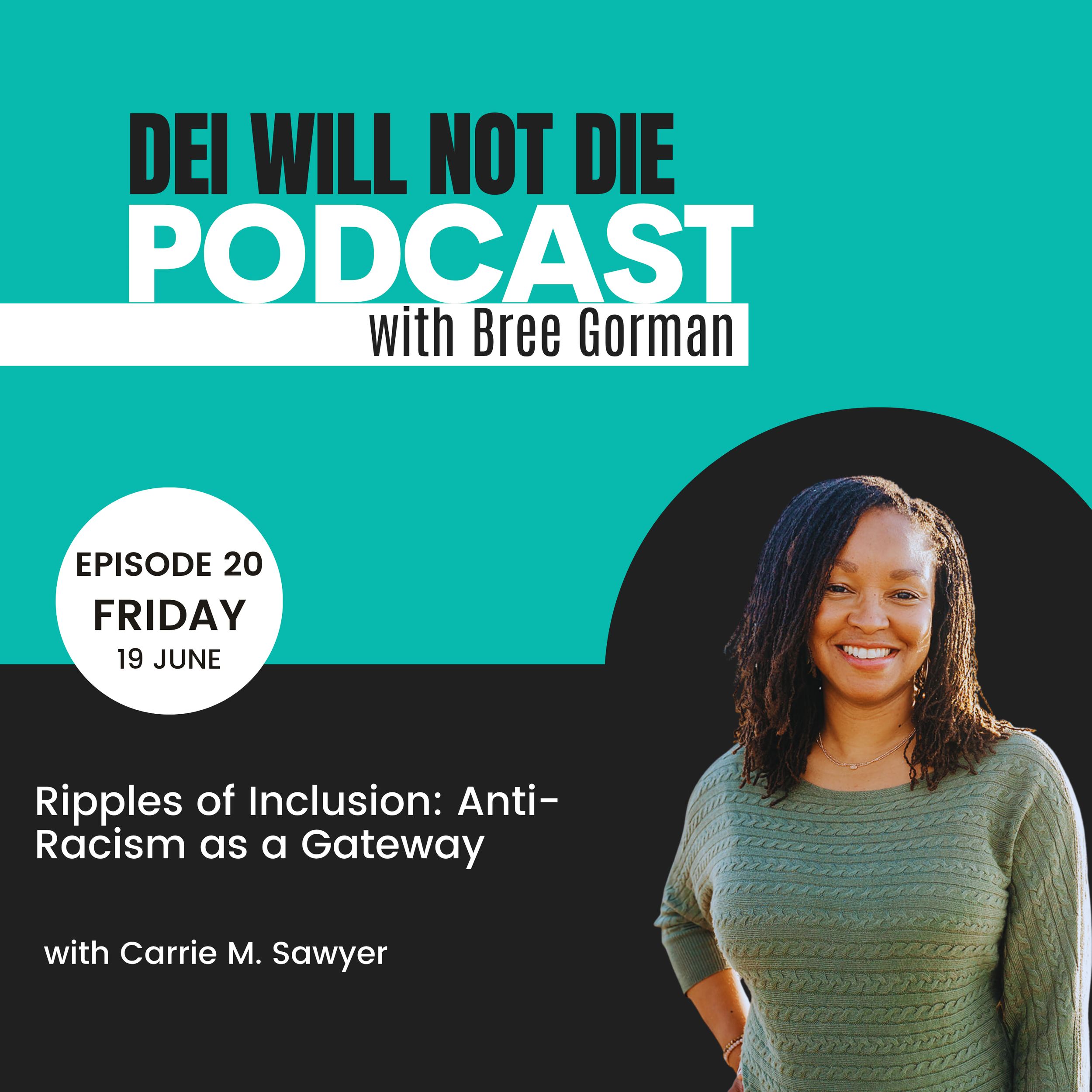
In this episode of DEI Will Not DIE, Bree Gorman sits down with author, speaker and design researcher Carrie Sawyer to explore her book, Ripples of Inclusion, a practical, question-led guide to anti-racism that grew out of the conversations people were having after George Floyd’s murder in 2020.
Carrie shares how hundreds of real questions from real people shaped the book, why anti-racism is a gateway to understanding every other -ism, and how the skills of interrupting harm are more transferable than most people realise. The conversation moves through the loaded assumptions behind "can't we just get along?", the difference between privilege and the gaslighting that makes it harmful, and what allyship actually looks like when you move beyond good intentions.
Carrie also shares the story of her six-year-old niece's Black Lives Matter lemonade stand and what happened when the neighbourhood showed up.
What You'll Learn
Why "can't we all just get along?" is more loaded than it sounds — and what it reveals about privilege
How gaslighting, not privilege itself, is what causes real harm
What allyship actually looks like in practice — and the six ways to show up as one
Why amplifying other people's voices means stepping back, not speaking for them
How small acts of interruption create ripples far beyond the moment
Resources Mentioned
Ripples of Inclusion by Carrie M. Sawyer — carriemsawyer.com
Keep Learning & Connect With Bree
Want practical strategies for navigating resistance and building real momentum in your DEI work? Access my free webinar on evidence-based DEI strategies here. It’s packed with tools you can start using today.
If this episode sparked ideas or questions and you want to talk more about how I can support your team or organisation, book a free 20-minute call with me. I’d love to hear what you’re working on and explore how we can move the work forward together.
And don’t forget to subscribe to my newsletter for fresh insights, events, and tools to support your inclusion journey. Because real change doesn’t happen in silence.
-
Well, hello and welcome back to DEI Will Not Die. I have my first international guest today, which is an exciting moment for the podcast — hopefully the first of many.
But before we get into that conversation, I want to start by acknowledging that I live, work and play on Wadawurrung country, and pay my respects to the elders past and present. I acknowledge that it always was and always will be Aboriginal land.
For our international listeners, Wadawurrung country is right down the bottom of what we call Australia. I'm about an hour south of Melbourne — so not far from there at all.
I want to call out to any Aboriginal or Torres Strait Islander people who may be listening, and to any First Nations people across the globe as well.
The guest I have on today, Carrie Sawyer, wrote a book called Ripples of Inclusion — the tagline is "turning your questions about anti-racism into action, allyship and activism." When I got hold of this book I was very excited to see if we could get Carrie to come on and talk about it — for a number of reasons. Anti-racism is something we need to be talking about and looking at far more critically in our workplaces, here in Australia and around the world. But also because of the way the book is structured — it speaks to anyone who picks it up, not just DEI practitioners or anti-racism experts. I think it's genuinely useful for the people we work with every day, and for people who haven't spent much time in this space before.
That's my little intro — but Carrie, I'd love for you to introduce yourself and tell us a bit about what brought you to write the book and how it came about.
Carrie Sawyer
Thank you so much for having me, Bree. I'm super excited to be here.
My name is Carrie Sawyer and I like to introduce myself as a mompreneur — I'm an author, speaker, podcaster, design researcher, CEO and nonprofit founder. I now understand how people become serial entrepreneurs, because I just founded a new organisation and I'm like, wow, that happened.
I like to call myself a master manifestor and an uplifter of people. I'm one of those people who believes we're all here for a reason — to help make the world a better place. Part of our calling is figuring out what that looks like, whether it seems large or small. Being the best mum or dad you can be is just as important as creating a company that cures cancer. They're all equally important.
Ripples of Inclusion was really about giving people an entry point into a topic that can feel really intimidating, gnarly, and scary. The idea was: here's what it is, here's how you can connect to it, and here's how you can define for yourself what interrupting harm looks like for you.
I talk in the book about anti-racism being a kind of gateway to understanding other isms as well — sexism, xenophobia, homophobia, all of it. These are transferable skills. As you read through the real questions people have asked and the answers, you can apply the thinking to things beyond anti-racism. The hope is that you take it, make it your own, and use it in your day-to-day interactions — so that when something doesn't feel right, you have a way in.
Bree
I love that. Even after about ten years in the DEI space, I still find anti-racism work intimidating at times — so it really resonates when you describe it that way. And I know if I still feel that, the people we're working with absolutely do too.
Can you talk a little about the structure of the book? Because I think it'll help listeners follow where we're going.
Carrie
Yeah, for sure. Let me take a step back and explain how it even came to be, because it really started with questions.
In 2020, after the murder of George Floyd, there was this great racial awakening in the States and around the world. People started coming to me with questions — not formal DEI questions, just questions from neighbours, colleagues, someone's daughter. And I found I wasn't the only one getting them.
This was also happening in the middle of the pandemic. So I thought, wouldn't it be great if we could get some people together and just talk? Whatever your question is — whether you think it's stupid, something you should have figured out long ago, or even a little bit racist — as long as you want to learn and do better, come and ask. And "getting people together" at that point meant Zoom.
I got a friend involved and we put it out on social media. I think we charged for the first two sessions, and then did about thirty — so the majority were free. We had twenty or thirty people show up, brave enough to come, with about twenty questions submitted ahead of time.
I'm a design researcher by background, which means I study people's experiences to improve them — usually in technology. When I looked at those questions, I thought: this is data. If I could collect enough questions, I could identify the major themes people are asking about and answer them in big buckets. That's how the book was born.
The sessions themselves were very come-as-you-are. We'd read a question exactly as someone had written it, and my friend and I would just answer — without much preparation. It was like someone had stopped us on the street. My friend and I don't agree on everything, so we were figuring it out together in real time, and I think that's part of what made it accessible. It wasn't polished or practised. It was: I think this, you think that, let's work through it together — while being respectful of each other.
We were also modelling how to have a conversation about sensitive topics with someone you don't necessarily know. And sometimes there isn't a right or wrong answer — a lot of it is context-dependent. Some chapters literally have three possible answers depending on the scenario.
The questions were real — regular people asking about their families, their workplaces, what they could do to do better. People of colour asking how to support the allies around them. Everyone just trying to navigate their own experience and make things a bit smoother.
Bree
I love where it came from. And I really agree — people often think there has to be a right or wrong answer, and sometimes that's exactly what paralyses them. They're so afraid of getting it wrong. But sometimes it's just about approaches that are more or less useful, and how we move forward together as humans having a conversation.
One of the themes in your book that really spoke to me was around "can't we all just get along?" — and I believe that's one where you had a rant warning.
Carrie
I did. I try not to rant, because that's not a safe space — but this one, I needed to.
The reason that question gets under my skin, even though it sounds harmless on the surface, is that "can't we just get along?" invalidates the experiences of people who are living through very real harm. People are having traumatic experiences. People are scared, attacked, killed. Saying "can't we just get along" kind of absolves you of any responsibility to think critically about why that's not happening.
It's easy to say "I'm a good person, I can get along with anyone" in the abstract. But when you're face-to-face with someone and there are differences in ideology, values, lived experience, safety — what does getting along actually look like in practice? We need to have that hat on: how am I aware of my own privileges and worldview, and how might those slam up against someone else's?
We also tend to think that if someone thinks differently to us, we're in competition — like we have to smash their view out of existence. But we don't. Your best friend, your partner, your child — there are probably multiple things you're diametrically opposed on, and you still find ways to connect, value, and love each other. The question is how we let differences live side by side while still respecting them.
And it's also about acknowledgement. You don't have to understand someone's experience, or agree with it, or choose it for yourself — but as a human being with their own autonomy, they should be able to live their best life however they want. The fact that they can't, because of what's going on — that deserves acknowledgement.
Bree
Yeah — it's a minimisation of what's happening, but it also reveals something about a person's level of privilege when they ask that question.
Carrie
Absolutely. And it's not inherently wrong or bad to have privilege — we all do. Sitting here having this conversation on a podcast is a privilege. But it's about our awareness of it, and how our privilege affects other people.
Someone asked in the book: why does privilege get people so worked up? And my answer was — it's not the privilege itself, it's the gaslighting that tends to come with it. When a person with privilege and access pretends that you have the same advantages they do, and they know you don't — that's what makes people see red. If someone says, "nobody's looking at you differently, that's all in your mind" — when the evidence is clearly there that it isn't — that's gaslighting. Telling someone that their lived experience isn't happening.
That's the part that makes people furious. When you acknowledge your privilege and say "okay, so what can we do about it?" — that's a completely different conversation. It's the denial that does the damage.
Bree
Yeah. One of the other things in the book that really stayed with me was the lemonade stand story. I was reading it on a train and it just — wow. Would you be okay sharing that one with us?
Carrie
Oh my God, I love that story so much. Yes.
So this is my niece. My brother Frank is a couple of years younger than me, and his daughter Grace was about six at the time — she's eleven now. Frank and his wife Katie hadn't talked to Grace or her younger brother Austin about what was happening in 2020, because the kids were just too little. But Grace had picked up enough to know that racism was happening and she wanted to do something about it — because that's just who she is.
She came to Frank and Katie and said she wanted to have a lemonade stand. And they both thought, oh no. Because this is a biracial family — Frank and I are African-American, Katie is white — and they'd recently moved to an affluent, predominantly white suburb outside of Detroit. And here's their six-year-old wanting to have a lemonade stand in that neighbourhood in 2020. This was a safety concern. But it was also their daughter leading them into a kind of activism they hadn't planned for.
So they decided to do it. Katie advertised in the neighbourhood Facebook group. And it was not just a lemonade stand — Grace had a Black Lives Matter sign on her table. This is a statement.
The day arrives. Grace sets up. Almost immediately, the neighbour from two doors down starts walking over — the one who puts out hyper-conservative signage in her yard in violation of the HOA and has never spoken to them. She walks up, reads the sign, looks at Grace and says: "Black Lives Matter — all lives matter."
Grace is six. She doesn't know about the "all lives matter" counter-movement. She just knows that black people are dying and her dad is black and she doesn't want that. So she just stares at the woman in complete bewilderment. And the woman stares back. And then, after a long moment, the woman throws down her money, takes her lemonade, and leaves.
Frank and Katie didn't have to say a word. The six-year-old won by just being a six-year-old.
But now they're braced for two hours of that. This was literally the first person of the day. And the opposite happened. Almost everyone who came out was supportive — people they'd waved at, people they'd spoken to in passing. The neighbourhood turned out for Grace. She made several hundred dollars, sold all the lemonade, she and Austin drank lemonade, they had a blast. And Frank and Katie made friends they still have to this day.
But there's one more part. A couple of days later, Frank is driving home and a car follows him into the driveway. Two white people get out — and he recognises the HOA president. He's immediately thinking, we're in trouble over the lemonade stand. He gets out of the car. They get out. And they say: "Are you Grace's dad?"
He says yes.
They say, "We are so sorry we missed the lemonade stand" — and they put money in his hand. "We completely support you and your family. We're so glad you're here."
Frank goes inside in total bewilderment and tells Katie what just happened.
What started as something Frank and Katie were genuinely scared about turned into this beautiful, unexpected thing — neighbours coming together, an eleven-year-old leading her whole family into something more than they imagined. And it really is a story about the bravery it takes to do something that seems small, and the ripple it can create.
Bree
That story really stuck with me. It actually inspired me to write a piece recently about LGBTIQA+ allies and how often the people you'd least expect turn out to be the biggest supporters — sometimes visibly, sometimes quietly. It generated a lot of thinking about the generalisations we make about people, and how often they're wrong.
It also shows the emotional load that Grace's parents were carrying in that moment — something a lot of people don't fully appreciate.
Carrie
It was so much more than a lemonade stand.
And hey — if you ever need another international guest, Grace is eleven now and still very much a little activist. I'll connect you.
Bree
I love that. Listeners, watch this space.
I want to ask one more question before we wrap up. In your book, someone asked: "I want to be an ally, but I don't know where to start beyond just speaking up when I see something." I get this a lot. People in my workshops often don't really understand what allyship means or looks like in practice. What would you say to that?
Carrie
Great question. In the book — which I strongly encourage you to get for the deeper dive — I outline six ways to be an ally. I'll name them all and then go a little deeper on one.
But first, something worth sitting with: people are always watching you. The things you say and don't say, do and don't do. There's always someone watching — a child, a neighbour, a colleague. We have this opportunity within our sphere of influence to choose what we model. And silence tends to function like co-signing. If you don't interrupt something, you're either saying "I'm too afraid" — which is valid, there are real power dynamics at play — or "I think this is okay." Either way, you're not interrupting.
I use this image in the book of racism as a giant old-fashioned wooden wheel rolling down a main street, clipping people as it goes. You can stand there and say "look, a wheel" — but that doesn't help anyone it's hitting. You have to get in there and do something to disrupt it.
The six ways to be an ally: always learning, always investing, always amplifying, always disrupting, always navigating mistakes, and always being comfortable being uncomfortable.
Bree: Can you go a bit deeper on amplifying?
Carrie: Yes. Amplifying is about getting voices to the table that aren't always invited or allowed to be there — and it's nuanced, because it's not about speaking for people. It's about clearing a space so their voice can come through, then stepping back and holding that space.
Being an ally doesn't mean saving anyone. No one wants to be saved. White people are not here to save brown people. Straight people are not here to save LGBTQ+ people. We all have the power to handle our own business — sometimes we just need someone to help kick in the door and hold it open. That's amplifying.
It can be as simple as: "Actually, Bree was speaking — can she finish her thought before we move on?" You've just created space for that voice without making it about yourself. And as an ally, it's not about your voice. It's about creating and holding space so that other people's brilliance can come through.
Bree
Yes — and I think it's one of the most powerful forms of allyship we have. Carrie, you are such a brilliant storyteller. I love how you share ideas.
We are out of time, so I'll wrap up here. I strongly encourage listeners to get the book. For those of you who've been in this space a while — buy it and give it to someone. Ripples of Inclusion speaks to a wider audience than a lot of the tools we have available, and I think that's exactly what makes it valuable.
Follow Carrie and check out her work — I'm really grateful you came on today.
Carrie
Thank you so much. This was super fun.
Bree
It really was. Thanks listeners — catch you on the next one.
Description text goes here