
Racial equality, but on whose terms?
About this Episode
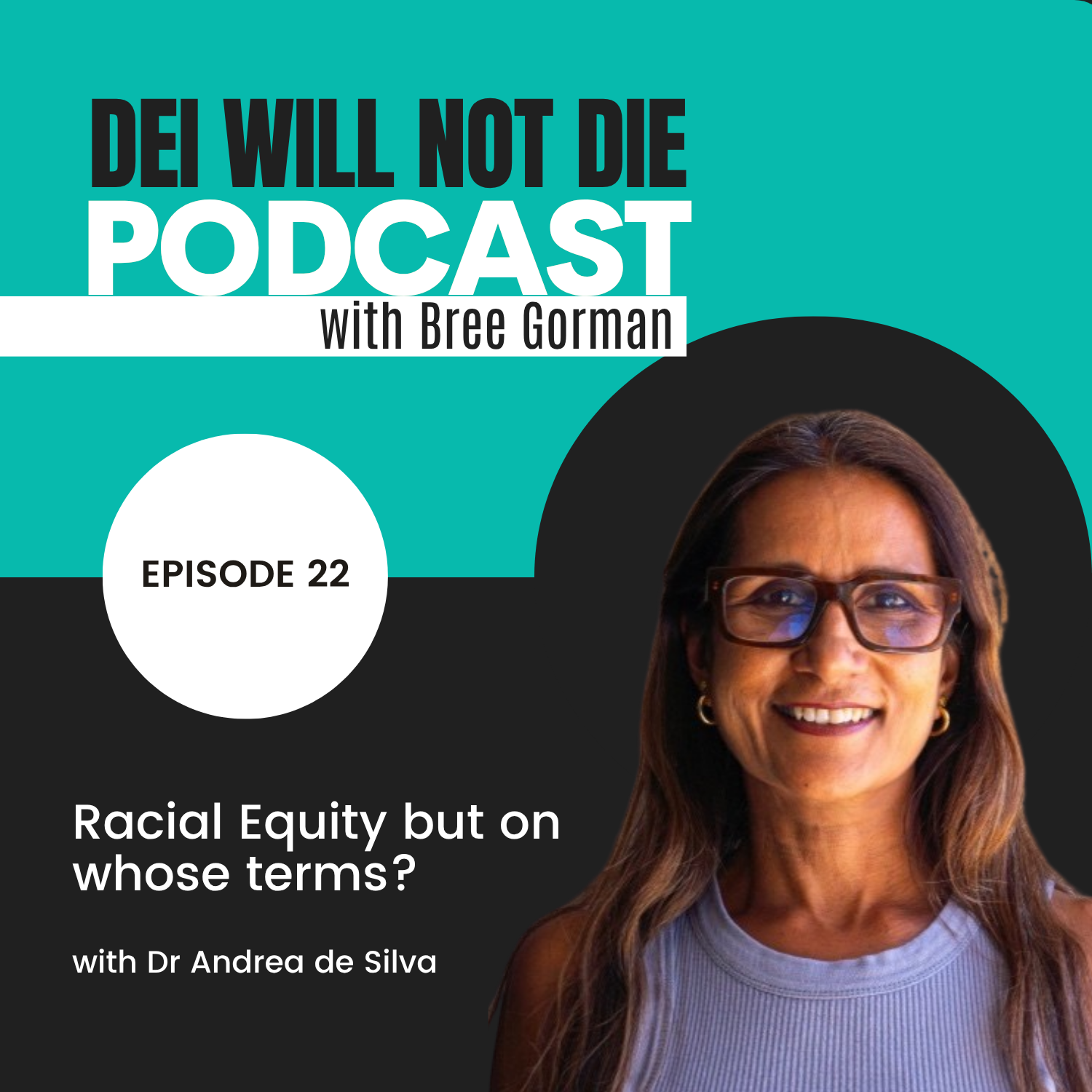
Bree sits down with Andrea de Silva, a friend and collaborator, for an honest conversation about what anti-racism actually requires inside Australian workplaces, and why most organisations get it wrong.
Andrea draws on her own experience as a woman of colour navigating largely white public sector organisations, including the toll of making herself "white enough" to be promoted. She unpacks the difference between individual racist behaviour and structural racism, why "I don't see colour" invalidates the people it is meant to reassure, and the question that runs through the whole episode: who actually gets to decide what equality looks like?
The conversation then turns to workplace complaints processes, where Andrea is direct about the harm they cause. All-white investigators and decision makers, the expectation that you educate the organisation about your own experience, the risk of being recast as the problem, and the people who quietly stop reporting because they know it will go nowhere. It lands on what leaders need to do differently, from building real racial literacy to genuinely handing over power.
For international listeners, Andrea also gives important context on the Australian setting, including the White Australia Policy that shaped her own family's migration.
What You'll Learn
Why racism is structural and systemic, and how that differs from an individual being racist
What the Australian context adds to this work, and why discomfort here is tied to unfinished truth-telling about the past
Why "I don't see colour" and being grouped in with white colleagues invalidates lived experience
The difference between cultural awareness and racial equity, and why understanding cultural differences is not enough
Who gets to define equality, and why a single definition can miss what would actually be meaningful to someone from a different cultural paradigm
How workplace complaints processes can cause harm rather than resolve it, and why people stop reporting
What leaders can shift: self-awareness and positionality, racial literacy, humility, and handing over real decision-making power
Why cultural safety and psychological safety go hand in hand
Resources Mentioned
https://www.humanrights.vic.gov.au/resources/guideline-workplace-race-discrimination/
Anti-racism resource suite (incl. racial literacy guide): https://www.humanrights.vic.gov.au/resources/workplace-anti-racism-resources/
Dr Tom Verghese, https://culturalsynergies.com
More about Dr Andrea de Silva can be found on her website: https://andreadesilva.com.au/ and on Substack: https://substack.com/@andreadesilva?r=33gxe8&utm_campaign=profile&utm_medium=profile-page
Keep Learning & Connect With Bree
Want practical strategies for navigating resistance and building real momentum in your DEI work? Access my free webinar on evidence-based DEI strategies here. It’s packed with tools you can start using today.
If this episode sparked ideas or questions and you want to talk more about how I can support your team or organisation, book a free 20-minute call with me. I’d love to hear what you’re working on and explore how we can move the work forward together.
And don’t forget to subscribe to my newsletter for fresh insights, events, and tools to support your inclusion journey. Because real change doesn’t happen in silence.
-
Bree: Hello and welcome back to DEI Will Not Die. I am again coming in today from Wadawurrung Country, the land that I get to live, work and play on. I want to send my acknowledgement to the Wadawurrung people and their elders, past and present, to acknowledge that this is absolutely Wadawurrung land, and to acknowledge the impacts of ongoing colonisation and how that has impacted not just the Wadawurrung people, but Indigenous people across the nation. And a call out to any Aboriginal and Torres Strait Islander people who are listening in to this podcast today.
We are going to head back into anti-racism territory, which I've been really privileged to explore. Such interesting voices have come on this podcast so far to talk about this topic. This one is a bit special because I would also call Andrea a friend, so we get to have an intimate conversation about it. We're going to take it in a few different directions today, so you're in for a bit of a treat. But before we get into the depths of it, Andrea, I'll get you to introduce yourself, tell us where you're coming in from and a little about why you found yourself on a podcast about DEI.
Andrea: Thank you, Bree. I'm feeling very privileged to be here, and thank you for the invitation and the opportunity to have this intimate conversation with you. I also count you as my friend, which is probably why I am here, but I've also had a really great experience working with you over the past year or two. I'm dialling in from Wurundjeri Country in Naarm, and I pay my respects to the traditional custodians of the lands, seas, waters and sky which I am dialling in from.
I have had a very long and varied career across a number of different professions, from being a benchtop scientist to a lawyer to a DEI consultant. Most of my career has been in research, as a research professional, and one of my passions is mobilising knowledge and working with people to identify problems and design solutions. That traverses all of the areas of my professional and personal life. I have only recently attached the label of DEI consultant to myself, and had, surprisingly, a level of imposter syndrome, which I've never really experienced before. But attaching that label, and trying to align my professional role and incorporate my lived experience, my cultural background and my life as a woman of colour in Australia, has been enriching, confronting, and quite a journey so far.
Bree: I know when we first started talking about some of this DEI stuff, you'd done quite a bit in the gender equity space, and you were focusing more and more on anti-racism when you had the opportunity to. Do you want to tell us a little about your approach to anti-racism work, or anti-racist work? I'm not sure how we use the language. What's the main approach that you take to this work?
Andrea: Thanks, Bree. When I first started working in it, I really thought I brought an intersectional lens. I didn't quite know what that lens meant, because... I try to steer away from jargon, because it can be very exclusionary. But in working in the gender equality space, my own lived experience, my reading and my background made it very clear that when middle class white women got into positions of power, they didn't dismantle anything. They didn't really change the landscape for women who didn't fit into that mould. So applying an intersectional lens brings in race, colour, socioeconomic status and class, which are all things that are important to me.
I could see that was an area that was really lacking a deep understanding in Australia. We were drawing on information, theory and evidence from the US or other parts of the world, but mainly from the US, which has quite a different context and application to the Australian context. So I could really see a need to go deeper into that space. One of the people who I think writes really well on this is Dr Tom Verghese, who brings a lens that applies in Australia to this work.
In terms of anti-racism versus racist: one is about structures and systems, and that is more the racism side of it. An individual can be racist in their approach, and that cuts across all racial backgrounds. We see caste systems, we see colourism, we see racist attitudes play out in all parts of society. But racism itself is structural and systemic. It's structures and power, and it's really about who's designing them and why they're designing those systems and structures in that way.
Bree: Can we go, just for a moment, into the Australian context? I noticed looking at the stats for this podcast that we are getting some international listeners. Can you explain a little about the Australian context when it comes to racism?
Andrea: Yep. The Australian context is quite different and interesting. Part of why I think Australians have such discomfort with talking about racism and racist behaviours is because they haven't fully reconciled with the past. Truth-telling is a very important part of reconciliation with Australia's First Nations peoples.
If I put it in my context, my parents migrated to Australia in 1971. At that time we had the White Australia Policy, which was a very deliberate attempt to keep Australia white. The only reason my family, who are not white, could come to Australia is because we came from Sri Lanka, and it had been colonised by many European colonial powers, so we had ties back to European descent. There were agreements, the Colombo Agreement and others, that allowed certain non-white people, but almost white, because we came from colonial structures, to come to Australia. But what that did mean is that I spent my childhood hoping nobody would realise I wasn't white.
So legally we were tied to British rule of law. The settlers, the colonial structures, were set up to mirror those legal structures. We had policies and laws that disallowed people who might infiltrate the white Australia, even though, of course, Australia was not white before colonisation. So that's a very confronting background.
I think one of the other points of difference is that, growing up as a brown child in Australia, you're surrounded by white people in power, and brown and black people are very far from that. Whereas if you're a newer migrant and you've grown up in India or Malaysia or another country where you're surrounded by brown people, and brown people in power, you have a different view of colour, race, power and positions. So Australia is distinctly different in that as well. My parents came under that law. It only got repealed in, I think, 1973, or the early seventies.
Whenever I've mentioned that, and I mentioned it recently at a conference where people were giving their migration stories, I told that and people just laughed uncomfortably and didn't know what to do with the fact that it's so recent, and it's a real and enduring legacy.
Bree: And we're seeing so much of that history get repeated by some not-so-great politicians currently in this country as well. If we bring it back to workplace inclusion, for want of a better term: you've talked about the structures and systems being designed by white people for white people, and yet they're not the only people in those spaces. What do you see as the role of white leaders specifically in this work? And where do they get stuck when trying to break down some of this structural bias and racism?
Andrea: I think we have to acknowledge that most leaders, in particular in the public sector, which is where I've spent a lot of my working life, are white. It's very rare to come across a non-white leader. I've been reflecting on this recently, writing about how I made myself so white that I was able to be promoted and progress in a lot of these organisations, and the toll that has taken on me personally.
If we come from the position that leaders want to create an inclusive workplace and have the best of intentions, where I think they get stuck is knowing what to do, and thinking that they are the ones to solve and design the solutions. I referred earlier to thinking about who's defining the problem and who is designing the solution. It's often not the white leader, who might have got their position historically through informal networks, friends of friends, referrals, connections, intergenerationally, for example, and they've got into those positions without understanding or experiencing some of the barriers that might be experienced by other people.
So one of the areas I try to work with leaders around is self-awareness: developing a self-awareness, and an understanding of their own positionality and privilege. And privilege is not a dirty word. I'm a very privileged person. I'm a woman of colour, of migrant background, but I'm highly educated, I speak English well, I've had a very long career. We all have our own privileges, so we have to sit comfortably in that, but lay it out and be transparent about it.
Then, around racial literacy. Some of the new guidance and anti-racism frameworks coming out of the Australian Human Rights Commission and the Victorian Equal Opportunity and Human Rights Commission are about people investing in developing racial literacy, and their knowledge about the people they work with, the different cultures, and what that means.
And then, humility. As a leader, you might think people always want you to know the answers, to solve every problem, and the powers that be might be expecting that. But coming from a position of both cultural humility and just general humility to work with people, that might mean relinquishing some power or decision-making, or holding yourself more to account. Coming from a position of "let's do these things together, because I don't know everything" is a very useful and helpful position to come from in this regard.
Bree: It's reminded me, when you were talking about racial literacy and racial equity, that for such a long time so many of us white folk in organisations have either been led to believe, and also quite willingly believed, that not being racist was about understanding and having cultural awareness. Quite often I'd talk to leaders and they'd say, "Yes, I understand there's cultural differences, and when Chinese people say yes they actually mean no." It's this simplification of the issue, like it's just about understanding cultural differences. But racial equity is quite different to that, isn't it?
Andrea: Yeah, absolutely. In workplaces, one of the areas where people feel that inequity more is around opportunities, and the concept of relational equality and those interpersonal interactions: where their ideas might not be picked up until a white male colleague says it, and then it's a great idea, or they're not asked to come to consultations or be involved in organisational decision-making.
If we come from a position of humanity and think about racial equality in that way, we have to think about people's different experiences of navigating the world, and even the workplace. When people say to me "I don't see colour," or they've grouped me in, and I've had this multiple times, they've grouped me in to "who are we, as a group of white bureaucrats, deciding this?" And I have to say, my God, I'm not white. I have not turned up at this workplace as a white person. But that's a reminder to me that I fit in so well, I've navigated the space to such an extent, that they think I've had the same experience as them. It's very disheartening and upsetting. That's invalidating people's experience, and what they have overcome to get into those spaces.
In terms of racial equality, I've been thinking recently about even that concept, because it's often somebody else deciding what equality looks like. If you come from a more collectivist culture versus an individualist culture, you actually might just want different things. Who decides what that equality looks like? Again, we're saying, as the leaders in the workplace, that we think racial equality should look like this. But we're not saying, "We come from a completely different cultural paradigm, and I don't even want that, that's not meaningful to me. What would be meaningful to me is this." You're telling me, and you might be grumpy at me because I'm not taking up this opportunity which you've decided. You might have moved heaven and earth to give me this opportunity, and I'm not taking it up, but actually you didn't ask me what would be meaningful to me. So I think there's a lot of depth to it.
Bree: I like that framing. We were talking earlier about accountability for this work, and more broadly for DEI work, but specifically in this context you gave a great example when we were talking offline about the complaints process, its lack of accountability, and its ineffectiveness in the way it was designed. Can you share with the audience some of the things we were talking about earlier?
Andrea: Yeah, absolutely. I feel very strongly about this, and I would say it's absolutely harmful, actually, what I've both experienced and observed, particularly in public sector organisations. Why it's harmful is because, based on my first experience, you're told that if there's a problem, you have these avenues to deal with it. And actually you're expected to do something. The law says that as an employee I have a duty to inform you of the issues and actively do something about them, because we have both duties and obligations.
So when you engage with this system, you suddenly realise that if you're bringing something, even if it's not a complaint about racist behaviour but about what you've experienced, and it's hard to confront an all-white or largely white organisation, to call someone out for racist behaviour, or even to say that you think the system is a racist system, that racism is entrenched in it. I've had examples where I've raised issues of my own experience, and then I've been labelled racist. A complaint against me has been put forward that I'm racist. And that goes against the whole reason we have racial discrimination laws, and how racism and racist behaviour is actually experienced, and who the powers are that design these systems. It's not brown and black people in Australia designing these systems.
Until we're ready to dismantle the current approach to workplace complaints, and redesign it, rethink it, actually get to the heart of the problems, we won't make any inroads, and we won't stop creating the harm that comes from having to explain how racism plays out. I went through an investigation process where the investigators are all white, the decision makers are all white, the adjudicators are all white, the people who have designed the system are all white. And I'm trying to explain how racism is embedded in this process, or how my experience has been racist. It's harmful, because you have to justify yourself, and you have to explain through the racial stereotype of the angry brown woman.
After probably my third experience, in another organisation, I told the investigator that if they didn't understand white fragility, I was prepared to educate them. After multiple attempts where I'd asked for the investigator or the decision makers to be non-white, I've been told every single time that there is not a non-white person available, that we don't have them in this organisation. So if you're confronted by that, how do you take forward a complaint about racism? You just can't. It becomes particularly harmful.
The other thing that happens is that there's this collective of brown and black people who experience these things in workplaces, and we talk, because you reach out, you want to support each other. And when everybody's hitting their head against the same concrete block, you stop putting in the complaints. You stop, because you don't want to be harmed, and you know it's going to go nowhere. So until we can be more accountable in that... and that's a tiny example, my experience is only a tiny one, but I bring it up to demonstrate how, on the face of it, of course we have a policy that says you can make a complaint and we will investigate it, but at every point in that process it becomes more and more futile. Then it goes back to a senior leader or the CEO, who's also white, and looks at it and says "that wasn't their intention," or "that's not really an issue," or "that's not significant enough for any kind of misconduct or punitive outcome." And in the process, every time, I have been so harmed by it that I've left the organisation. So that's been the outcome for me.
Bree: Wow. It's crazy how often I hear these kinds of stories about the complaints process. I know there'll be listeners tuning in and thinking, from a disabled lens, or an LGBTIQA+ lens, there are some similarities here in the way those complaints land. Coming from minority groups, there's minimal representation in the people who control those processes. So what you're describing is an experience where not only have you been harmed by the incident, but then it's somehow your job to educate the organisation as to why that was harmful.
Andrea: Yeah. And then there's the risk, and it is a risk, that they'll turn around and say "we need to do anti-racism training," because suddenly there's a spotlight, and then you're seen as the person who said the organisation needs it. It becomes like you're the problem. It continues to perpetuate this issue that you're the problem, and people like you are the problem.
Bree: Yeah. So you talked earlier about ways organisations could rethink designing their complaints process, and it sounds pretty simple, I think, your answer. But give it to us, because it's important that people hear it.
Andrea: I think absolutely power needs to be handed over in these processes. Yes, we have laws, we have guidance, we have obligations, but there are different ways to comply with all of those things. Until organisations, and those white colonial structures, hand power over to people, and you don't even have to be in power in the organisation to be able to make decisions around how to structure a complaints process, what some of the requirements are if you've got a cross-cultural issue or power imbalances... We know that racism and racist behaviour is both lateral, between colleagues, and vertical, across the organisation. It manifests in so many different ways. So we have to be more creative in how we address these problems.
I would say that in general about all workplace interpersonal issues, actually. As soon as we decide "this has to be investigated," get an investigator in, "you two don't speak to each other, we're going to investigate, we're going to call witnesses," everything just blows up. That bridge is burnt pretty quickly and it's very hard to recover. So I think that in general, but then if you overlay racial elements onto that, it becomes very fraught and very difficult to address in a way that will get a positive outcome for everybody. Because if we can have an outcome where people learn more about each other and enhance their knowledge and racial literacy, that would be a really good outcome. But until we have more culturally diverse investigators, and a deeper understanding of the different ways that racism can be experienced... and I hesitate to use the word racism, because my whole life experience of having to change my accent, from my Sri Lankan accent to my Aussie accent, which now I can't even control anymore, versus being told that people don't see colour... You don't necessarily have to put that label on it. It's just seeing people for who they are and how they might be experiencing and navigating the workplace. I think that's very helpful.
Bree: Yeah. Wow, what a conversation. I knew we would have a good one, but I've learned so much listening to you, and thank you for bringing in your personal stories too. I know that's an extra emotional load that people carry in this work, so thank you for sharing that openly with us. I'm sure the audience has got a lot from it. Can you share where people can find you?
Andrea: Yes. I'll give you a Substack link for the show notes, and I have a website and LinkedIn. I'd really love to engage with people to talk deeply about these issues. The only other thing I would add, which I didn't mention, is around the issue of psychological safety, and how cultural safety and addressing issues around discrimination go hand in hand with psychological safety. You can't have one without the other. That's the final thing I wanted to mention. I'll put the Substack, the LinkedIn and some website addresses in your show notes. Thank you very much.
Bree: Awesome. Thanks for having the conversation with me, and thanks everybody for listening in.
Andrea: Thank you.