
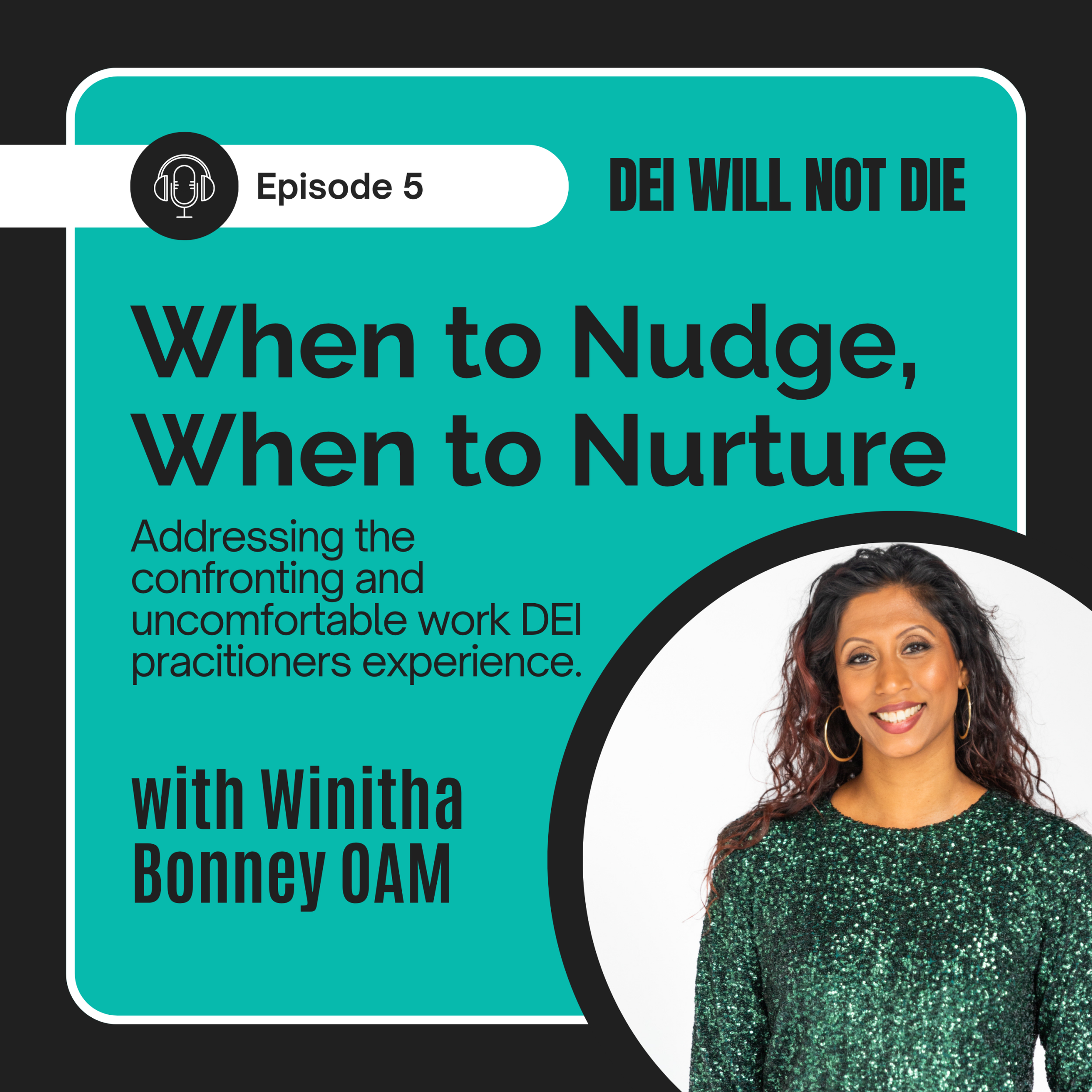
Episode #05
When to Nudge, When to Nurture
About This Episode
In this episode of DEI Will Not DIE, Dr Bree Gorman is joined by guest speaker Winitha Bonney OAM to discuss engaging leaders and more broadly organisations as a DEI practitioner.
This work can often be confronting and uncomfortable, and DEI practitioners can meet a lot of resistance from leadership. How do we influence them to get involved, and how do we understand what drives them? As Winitha describes, sometimes we have to nurture our leaders, creating safety to then nudge when we need to.
Bree and Winitha share past experience on how they’ve navigated these situations, and what strategies have helped them know when to push forward and when to pull back and re-assess.
For tools, coaching, and support: breegorman.com
What You'll Learn
● How to nudge and nurture people into DEI work
● The importance of presenting the information to your audience in different formats
● How to avoid indefinite project timelines
Resources Mentioned
Keep Learning & Connect With Bree
Want practical strategies for navigating resistance and building real momentum in your DEI work? Access my free webinar on evidence-based DEI strategies here. It’s packed with tools you can start using today.
If this episode sparked ideas or questions and you want to talk more about how I can support your team or organisation, book a free 20-minute call with me. I’d love to hear what you’re working on and explore how we can move the work forward—together.
And don’t forget to subscribe to my newsletter for fresh insights, events, and tools to support your inclusion journey. Because real change doesn’t happen in silence.
-
Bree: [00:00:00] Is DEI dead? Not even close. I'm Bree Gorman and this is DEI will not die the podcast for people doing the real work of inclusion. Whether you are leading a team shaping DEI strategy or just trying to make change that lasts. You're in the right place. We will cut through the fluff and dig into practical insights that will help you lead with clarity, courage, and impact.
Want more tools and support? Head to breegorman.com
Well, welcome to DEI Will Not Die, and I'm gonna start this episode by saying that I am completely in brain scattered mode this week. It's this beautiful combination. Perimenopause and ADHD creating a waterfall of fun experiences. So we're gonna [00:01:00] roll that straight into our conversation today with the wonderful Winitha Bonney, who I am so privileged to know and have been able to actually meet in person, which is not always common in the dei
Space. So I'm so glad to be able to say another chat today with a friend and somebody who I deeply respect in the space. So Winitha, before I throw to you, I do wanna just acknowledge that I'm on Wadawurrung country. Pay my respects to elders past and present, and any Aboriginal and Torres Strait Islanders who are listening in on this podcast, always was, always will be aboriginal land.
And I'm gonna acknowledge that I as a visual description for those who require it, either because you're required or you're not watching the YouTube streaming, is that I'm wearing blue glasses. I'm in desperate need of a haircut. So I've got a good curly mop on top of my head and I'm wearing a green shirt.
And I am rocking back and forth in my chair to help me [00:02:00] manage my A DHD today. I'll throw over to Winther to introduce yourself. Thank you so much, Brie. I am grateful to be dailing in for the lands of the Yugambeh Language region of the Kombumerri families. And I am also not so much swinging in my chair, but I am swinging my legs.
We're twinning today. We're twin today. Yeah, I'm Swinging today. I am wearing a hoodie today, which is just deeply, deeply comforting even where I am, which is up north, which is a little bit more warmer than down south. But I am sitting in my chair swinging my legs with a hoodie. With my hair, with my curls all pulled back.
Actually,
it's funny you talk about the weather. It is freezing down on water and country at the moment and I have just like succumbed to buying a heat mat that sits under my feet. So that's the kind of stage of life I'm in. Yeah, [00:03:00] all about that. So I thought today. You recently came onto my coaching program, DEI Impact, and you had a conversation with the participants about influencing leaders and others, not just leaders, but anybody in the space of DEI.
And I thought that'd be a great topic to explore further because I learn a lot from what you were saying and there's some things I, I think there's a real unique perspective that you bring to this work. And I'd love, I know you've been doing DEI for a long time, so I don't need you to give us a whole bio on your extensive career, but I'm really interested in the overlap that you have between grassroots activism and you know, your foundation in that space, and then blending that into corporate DEI work and the, I guess, where those two influencers come from and how they work together today.
Great [00:04:00] question. I have absolutely no idea what I said last time.
I'm hoping it was profound. It was definitely profound. Oh my gosh. Yeah. I guess for me, I guess the overlap, really, and you would know this in the work that you do, is that there's so much noise. So whether it's grassroots activism or you're in a room with a bunch of leaders, people are surrounded by a lot of noise that's happening within them.
To the conversations that they've been exposed to. There is a lot of noise that's kind of happening around them. And it's this art of how can we cut through the noise? How can we make it so that whatever is needed to be heard is singular in that moment is is heard. And so with with, for me, it wasn't so much protests and things like that with grassroots activism.
It was more of the keyboard activism sort of kind. Yeah. And it was really understanding who, who are the people in positions of power that I needed to speak to? What were [00:05:00] their names? What were their contact addresses like? I would just try and work out their email address and then send them a very long email, like in size eight font, like literally that long.
You're like, you a must. You must. Yeah. And it's. Also connecting people together of like, okay, well here's acknowledging, here's a problem. Okay, what are we gonna do to solve it? I think that's the heart of all the work that I've done, not just in the DEI space, but also outside of that is, you know, how long will we, particularly in government, right?
Like how long are we gonna keep talking about the problem? Because we all know what the problem is, nothing's gonna create change. Just purely just talking about it, what are the solutions? So a lot of, in both grassroots activism as well as in the corporate space, it's. Acknowledging this is a problem, as if it was a statement, here's not what's not working.
We think it's because of these drivers. So as a result of this assumption, here are the three things that I think we should [00:06:00] be doing right now, and here are the resources that we need. Let's collect the resources together. Let's make it happen. Let's do it. Yeah. And um, it's the practicality, this of it, but then also the empowerment, which is.
You can't do this. Got it. When you describe that, my first thought is how you just establish that this is the problem we have, and I know so many people who be listening, and I've had this time and time again where you get so stuck, particularly with leaders in the definition of the problem. Is this really a problem?
Do we believe the data, hang on, that data point's wrong. How do you get people to, and I know there's no. Clear, easy answer to this, but how do you get people to really just come to agreement that there is a problem and this is a problem, and we need to move on and try and fix it, rather than focusing all of our time on continuing to define the problem.
I think sometimes it's, it is just saying exactly what [00:07:00] you just said,
literally word for word and being, being courageous to say that in that space. Yeah. Yeah. It's like, okay, well if you think this data set is inconclusive or you think there's something lacking, then to please tell me what you think needs to happen and in what timeframe. And that's probably where I maybe lose my S-H-I-T-A little bit
where I need to be, like being calm in the moment. But it's, yeah, I, I think a lot of it is sold in upfront. So, you know, for example, when I do a, a root cause analysis or diagnostic is in the planning. So this is what we're going to do. This is how we're gonna collect it, this is how we're gonna analyze it.
Since who's gonna be on that team and including everyone on that, but also being very vocal and very clear that if you have any concerns, like this is the time to talk about it. Not at the end. This is the time. And if they have problems, then that's when I'll cut them short and be like, this is actually not [00:08:00] appropriate.
'cause you had your opportunity then, and I, I respect that. This is an insight that you've only gleaned now, but now it's too late. Yes. So on a scale of one to 10, how big is this a problem for you? Let's deal with the ones that are like six to 10. Okay. If it's a six to 10, what do we need? Or what do you need to make that a 10 out of 10 where you know it becomes.
Hang on. My data is all wrong right now. Well, I was following to make this a one outta 10. Sorry, not a 10. Outta 10. We don't need a 10 outta 10 problem. We wanna avoid 10 outta 10. We can't go there if you like that.
So it's, it's like, it's kind of reverse. It's, it's like coaching. So that's why my brains like, so, you know. Can also be covering from a code. But anyway, so it's like, you know, in coaching we, we, we would say, okay. On a scale of one to 10, [00:09:00] where are you in terms of achieving this goal? Mm, it's a five outta 10.
What do we need to do to make it 10 outta 10? Like, so you've nailed the goal and with problem sets it's act, it's the reverse. So, yeah. Yeah. In, in an i, in an ideal world, and sometimes people just need to be coached in that, but coached in a very, very hyperfocused way to wrap up the conversation. Because as you know, in corporate, people will just, and what they're doing is they're just delaying the solution.
Yes. Delay like the point where they have to make a decision. Yeah. To move forward. Yeah. You know, I wonder sometimes if this is, and this has been my experience, that it's actually sometimes easier to do this as a consultant than as an internal. Because as a consultant, when we start the project, it's very clear our milestones and deliverables.
Yeah. And it keeps everybody to account to that. Sometimes when you're running one of these projects internally, you don't define. The milestones and the points at which you say, yeah, you know, you already had the opportunity to [00:10:00] respond to this. That time has passed. We're onto the next phase. I think sometimes that's easier for us as consultants and perhaps it is for those doing the work internally.
I think a lot of that, like all of that is monetary, you know? Mm-hmm. So companies wanna know exactly, you know, what are we getting our money's, money's worth? So they, they, they're, they're not into the, you know, the stuff up here. They, they wanna know very, what are the clear, so like you will know in this work, right, that in our proposal, specify what deliverables, the key deliverables are, what the process is.
Kind of where we hope to end up, but deliverables and outcomes, it always has to be very explicit and very clear, and I think that's more monetary focused. And I, I really believe that is the value of having a consultant in. Mm-hmm. And yes, you'll be paying them more money per hour than you will be paying someone internal.
But money is, it's not always about money, like money's actually a lever point to help get some of those outcomes. And I think when it [00:11:00] comes to employees, we think because everyone's paid on a salary and everyone's paid, you know, a contract that just has no end date. So it's like we've got all the time in the world.
Yeah. We'll just keep making you do more and more. Yeah. And, and maybe that's helpful learning for those, doing this work internally, that to really set up your project from the beginning as if you were an external consultant and there's very clear timelines that people have agreed to so that you don't have that.
I've had it before where three or four months you're arguing over one data point in a pay gap analysis. Like there's just no time for that in this work and it's not useful or impactful. It is just distracting. I'm interested in, you know, one thing and I will remind you that you spoke about in the last time we spoke, how you might nudge and nurture.
Someone to bring them into the work and to influence them into the work, particularly people who are new or maybe just that slightly a little bit fearful or resistant of DEI work. [00:12:00] How does that look? Are you able to talk about what this nudging and nurturing looks like? Yeah. I think, you know, coaching is a really powerful tool.
I know within the leadership space, it's becoming more and more a requirement in terms of a foundational skillset. So not just being coach, but actually being able to have coaching conversations with team members and things like that. So, you know, particularly as DI practitioners, I think people can feel very, um.
Sensitive.
I should also say I've had a lot of sugar today. Um, very, very highly sensitive to being told by us. Yeah. You know, was also, 'cause a majority of us, like I would say 99.999999999% of us do have lived experience of marginalization discrimination. So I think when we are telling people what to do, that can be very confronting to people.
And so for me, it's [00:13:00] creating a space for people to feel as if they've come up with the answers themselves or come to that clarity and that decision making themselves. And it's through having coaching conversations, asking really powerful questions about, in an ideal world, what would an inclusive culture look like?
Something that's really like expansive and open-ended. You know, if this problem wasn't to exist in our organization, if this was a hypothesis, what would that hypothesis be? What would the assumptions be? Another one can, that can be a little bit confronting for people is if there was a situation, it's like, what part of you played in this as a leader?
What has your role been in that? And so that's a little bit more of the nudging and the nurturing is more, I guess, into a space of, you know, possibility and solutions and so forth. Sometimes it's taking people out for a walk and just having that one-on-one. You know, just walking out in nature can be really a really powerful thing.
And just having that conversation with people to just call things out. I think you've gotta pick your moments though. Like I can be a very, very direct. [00:14:00] I can be very indirect, but I can be very direct. Like I can, I can, I will just go into this big story and people will be like, what was the point? I was like, I don't know.
The story was so big, I forgot
I was overwhelmed by the importance of the story myself. I know. And then in coaching conversations like my mouth has worked faster than my brain and people like. Know, someone was like, why can't I just be like this? I'm like, because you are unwilling to do what is required. And they're like, whoa, distract.
I was like, yes, sorry. Sorry, not sorry. And so it's like picking those moments with those individuals. I think it's, you gotta like know the individual. I think a really key thing is if there's any resistance to the work, it's knowing what is sitting behind that resistance in the work that we both do, we know a lot of that is driven by fear.
A lot of that is, you know, I guess what is in front of the fear is, you know, [00:15:00] reputational damage and what that might mean to a person's like status. Mm-hmm. Even if it could be like a, you know, a brand status as well. Yeah, and it's, yeah, but I think at the heart of it, everything is driven by fear.
Sometimes. It's naming the fear and yeah. I think with the nudging and the nurturing, it's the nurturing. Obviously everyone loves it. The nudging. You gotta pick, you gotta pick your moments. Yeah. And sometimes it's been, it's gotten into a point where I've had to say like, there was a client, which I think I shared with you privately, but you know, there was a client where they put the work on hold for a whole year because of all the changes that were happening internally.
And I gave them the grace to do that. Three months, went past six months, went past nine months, went past, and then I, I put the brakes on and I sent them a, I think it was literally one line. I said, do you have plans to reschedule this work for this year? If so, let's put new dates amongst all the deliverables.
If [00:16:00] not, you need to pay out the contract. And that was, for me, that was a very, very firm, a very, very firm nudge. Yeah, in in meetings I've had to say to people like, I understand things are really busy. I understand you have competing priorities, and if this is not a priority for you right now. Then we need to have a conversation about what I'm doing now.
Yeah. I really like the way you're kind of taken us into those, those moments where you have to decide, you know, am I here just to be nice and smile and get through it? Or am I here to really try and push the point a bit and get the change? Because as you say, the organizations and leaders individually just get paralyzed by that fear sometimes, but also just everything else gets prioritized over this work.
And so we do need to sometimes just push that little bit harder and say, Hey, hang on. You really are pushing this work to the bottom of the pile. If you're not committed to it, then let's not do it because it does not make sense to [00:17:00] try and do this work if you are not committed to it. 'cause it's hard. And it requires courage to push through some of that fear.
And we need to have, we need to work with organizations that are, that are willing to do that. And at the point they were willing to do that. That's scary I think for a lot of practitioners because. We often carry the weight of multiple communities with us in a space, and so unfortunately, I've learned that sometimes we do need to let go and actually create that space for people to stumble and fall and for a whole moment to happen, because until people feel that it's like that pain and that pleasure, you know?
Mm-hmm. In that, in this work, we have probably like 90% of companies that do it because of pain. Maybe 20% do it because they feel like it's the right thing to do and you wanna be proactive and it's all part of who they're, and things like that. So, but actually creating that space for people to make mistakes and to stuff up, you know, but also knowing that we can't, we actually can't control everything [00:18:00] and we can't save the world, you know, and we can do our little bit and do our dent, and we do need practitioners to keep going.
But also for me, it's also been a space of like leading. So it's like how am I being enabling and how am I being leading, how being a leader and for me sometimes being a leader is stepping out. Mm. With that client, it was to step out and also take action outside through different systems and avenues of being vocal because.
I know that having a conversation with them is not going to be very productive. But also their behavior, in my view, the world has been highly unethical. Mm-hmm. But there are avenues and ways that I can take action in that space. Mm-hmm. And so sometimes it is, but it is scary. Yeah. It is really scary. But for me it's like how am I choosing to lead in this moment?
Also, how am I choosing to lead myself? Mm-hmm. As marginalized folk, you know, we've had to, a lot of us have had to be the nice person. And [00:19:00] the quiet person and play it on the dl, on the down low. And it can be very confronting to be vocal and to be very assertive and to be labeled as X, Y, Z, as a troublemaker and you know, and things like that.
But then that's what we have to go back to the root of what this work is, which is activism. And activism doesn't mean that everyone skips around in a paddock with butterflies and daisies and. Rainbows and unicorns, you know? Mm-hmm. It's deeply confronting. It's uncomfortable. People have actually paid with their own life in multiple communities.
They have paid with their own life for this work. And you know, even with me, with that client, I knew that I would lose a friendship that I'd had for many years. I knew that I, there could be reputational damage to me. If they had chosen to speak with other clients, potential clients in that industry, but for me, standing up for myself and saying that this is not okay [00:20:00] was more important than people having their 2 cents being vocal to say, actually this is, this is not okay.
Yeah. And it's, you know, there's no right or wrong in these examples and spaces is there, and it is about making sure that those of us doing the work also look after ourselves and you know, that our work matches our values. And it's not always going to, sometimes you do have to, you know, give a little bit knowing that you're creating a little bit of change, not the change you wanna see, but at least it's moving in the right direction.
And we just have to make those decisions case by case and sometimes. As you've described and as I've had to do too, you, you just have to walk away or move away from that work because it's not, it's not the right place in the right time for you with your ideas and practice and yeah, that's not our fault.
Right. I'm conscious of, of time and I'd love to just ask kind of a final question around. You know, if [00:21:00] you could give, you know, one piece of advice to someone who's either working as a consultant or is perhaps on their leader of their employee resource group, or doing DEI work as a DEI practitioner internally, and they've got leaders who are resistant to change.
What's kind of one piece of advice or one question you'd, you'd want 'em to ask themselves, or what's kind of a message to leave with them? What is the cost of not doing this work? And what does it impact and how do we capture that in a way that is relevant and meaningful to those individuals? It's kind of like the leaders are like your consumers in a way, or your audience.
And how do they like the information digested? What are the best ways to do that? Is there someone on that team who is more of an ally? Could we partner strategically with them? How do they consume the information? But I think for me, [00:22:00] it's always coming at from the perspective of pain and you know, what is the fundamental cost of not doing this work?
Not just in the short term, but in the long term, the long term as well, and then capturing that in multiple different ways and avenues that we can. So it's like identifying the pain for the organization if they don't do this work, and understanding what might drive those leaders to really commit and get involved.
Yeah. Take 'em for a walk. Is that what you're saying? Yeah. Sometimes it's as simple as that. Yeah. Just taking them, I have done that multiple times actually. Yep. Whatever country they're in. If there's a traditional owner group organization that do walk walks on country, I'll actually organize it. And after the walk they get it.
And sometimes it's so much more powerful than a business case or a social case, whatever, whatever case. Yes. Or some kind of graph showing representation numbers. Yeah. Yeah. And I've done it, like I just thrown in at them multiple different ways. I looked [00:23:00] for all the opportunities like the DEI days, you know, we've, we've done walks on country, you know, I had a trans person come in and speak to an organization on International Women's Day.
And I brief that person about, you know, their own story. And you know, we always, when we talk about our stories, we talk about it from our, our wounds and our scarf. It's in a way that's going to be safe for anyone in the audience that might identify as well, but also keep it real, um, keep it real. And so I think when it's really intimate and when it's based around storytelling and different experiences, you know, having meetings in, for example, in Victoria with the Pride Center.
Having meetings in there, it's just, it gives people different experiences to inform not just their heads, but their hearts as well. And it's not just always about the business case. I'm a really big believer in experience. Somatic immersive. Yes, 100%. We're all people. Yeah. Thank you so much for, I know [00:24:00] you are struggling with a bit of a cold and we've managed to have a, hopefully, what is a rational conversation that
right.
But yeah, hopefully listeners you've picked up something from there around influence and and resistance and you know, there's so many different ways to approach this, but I think there's some, you know, really great easy takeaways from there that we'll make sure, uh, in that the show notes. Thanks Winitha.
Thanks everyone for listening in.
Well, that's it for today's episode of DEI. I will not die. Want more resources and support to do the work Well, why don't you visit breegorman.com and don't forget to follow or share this episode with someone who cares, and maybe also someone who [00:25:00] should.